DOJ-OGR-00010757.jpg
Extracted Text (OCR)
Castate0:20G0SMBBAAIN DinoneTatas3 Alei@a2522 RtagedacifS353
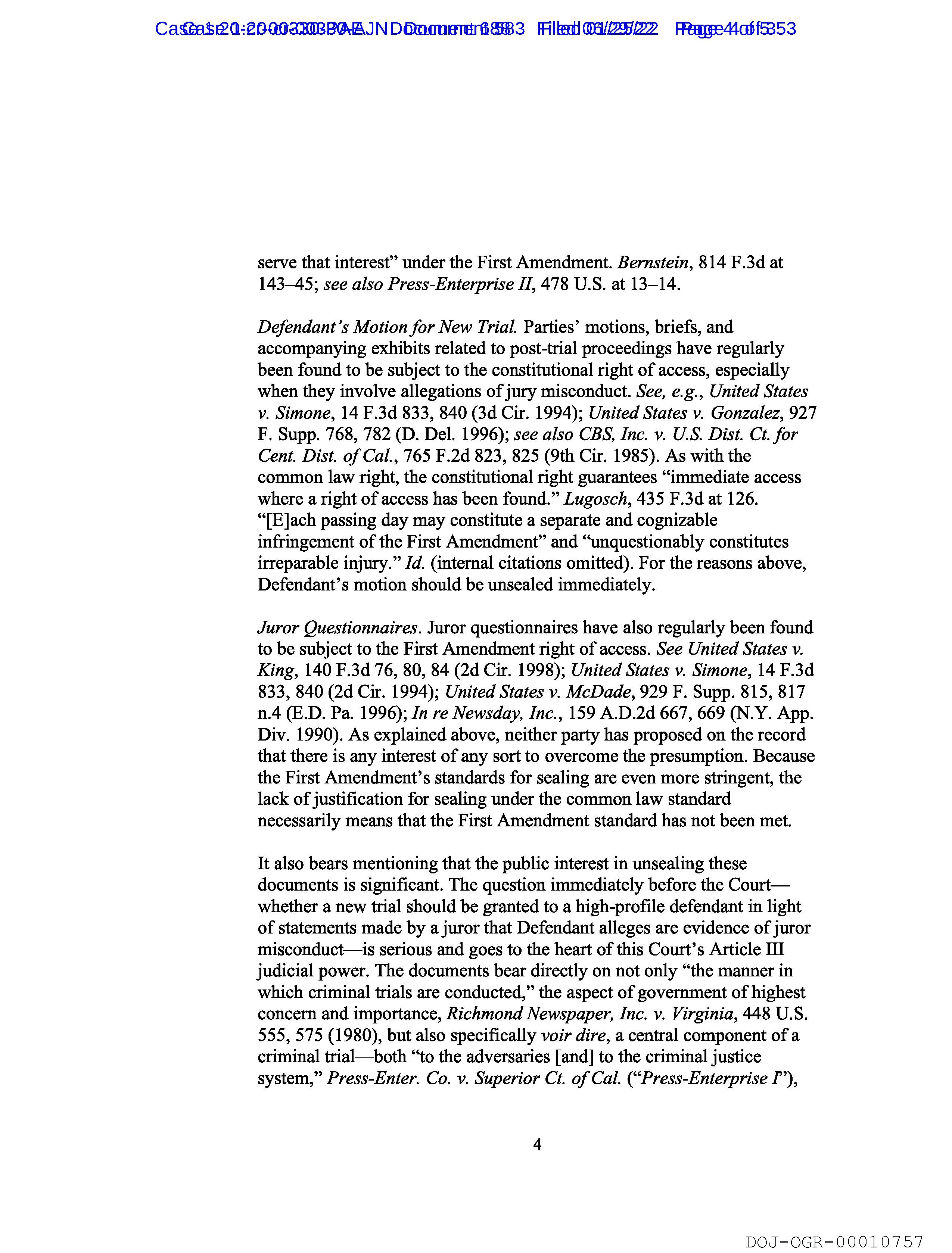
serve that interest” under the First Amendment. Bernstein, 814 F.3d at
143-45; see also Press-Enterprise IT, 478 U.S. at 13-14.
Defendant's Motion for New Trial. Parties’ motions, briefs, and
accompanying exhibits related to post-trial proceedings have regularly
been found to be subject to the constitutional right of access, especially
when they involve allegations of jury misconduct. See, e.g., United States
v. Simone, 14 F.3d 833, 840 (3d Cir. 1994); United States v. Gonzalez, 927
F. Supp. 768, 782 (D. Del. 1996); see also CBS, Inc. v. U.S. Dist. Ct. for
Cent. Dist. of Cal., 765 F.2d 823, 825 (9th Cir. 1985). As with the
common law right, the constitutional right guarantees “immediate access
where a right of access has been found.” Lugosch, 435 F.3d at 126.
“[E]ach passing day may constitute a separate and cognizable
infringement of the First Amendment” and “unquestionably constitutes
irreparable injury.” Jd. (internal citations omitted). For the reasons above,
Defendant’s motion should be unsealed immediately.
Juror Questionnaires. Juror questionnaires have also regularly been found
to be subject to the First Amendment right of access. See United States v.
King, 140 F.3d 76, 80, 84 (2d Cir. 1998); United States v. Simone, 14 F.3d
833, 840 (2d Cir. 1994); United States v. McDade, 929 F. Supp. 815, 817
n.4 (E.D. Pa. 1996); In re Newsday, Inc., 159 A.D.2d 667, 669 (N.Y. App.
Div. 1990). As explained above, neither party has proposed on the record
that there is any interest of any sort to overcome the presumption. Because
the First Amendment’s standards for sealing are even more stringent, the
lack of justification for sealing under the common law standard
necessarily means that the First Amendment standard has not been met.
It also bears mentioning that the public interest in unsealing these
documents is significant. The question immediately before the Court—
whether a new trial should be granted to a high-profile defendant in light
of statements made by a juror that Defendant alleges are evidence of juror
misconduct—is serious and goes to the heart of this Court’s Article II
judicial power. The documents bear directly on not only “the manner in
which criminal trials are conducted,” the aspect of government of highest
concern and importance, Richmond Newspaper, Inc. v. Virginia, 448 U.S.
555, 575 (1980), but also specifically voir dire, a central component of a
criminal trial—both “to the adversaries [and] to the criminal justice
system,” Press-Enter. Co. vy. Superior Ct. of Cal. (“Press-Enterprise I’),
DOJ-OGR-00010757
Document Preview

Click to view full size
Document Details
| Filename | DOJ-OGR-00010757.jpg |
| File Size | 929.7 KB |
| OCR Confidence | 94.2% |
| Has Readable Text | Yes |
| Text Length | 2,631 characters |
| Indexed | 2026-02-03 18:01:54.250037 |
Related Documents
Documents connected by shared names, same document type, or nearby in the archive.