DOJ-OGR-00021716.jpg
Extracted Text (OCR)
Case 22-1426, Document 79, 06/29/2023, 3536060, Page69 of 93
56
B. Applicable Law
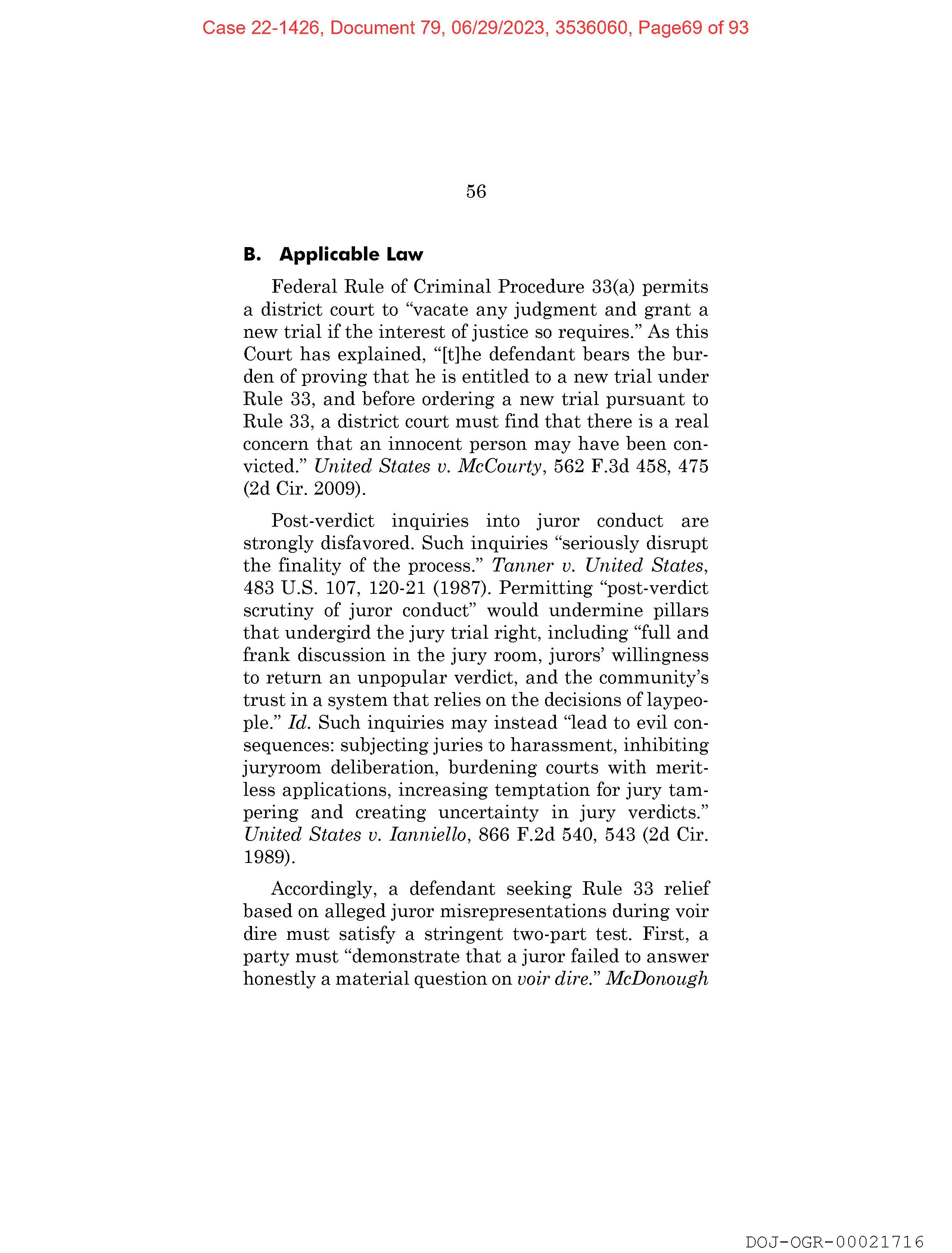
Federal Rule of Criminal Procedure 33(a) permits
a district court to “vacate any judgment and grant a
new trial if the interest of justice so requires.” As this
Court has explained, “[t]he defendant bears the bur-
den of proving that he is entitled to a new trial under
Rule 33, and before ordering a new trial pursuant to
Rule 33, a district court must find that there is a real
concern that an innocent person may have been con-
victed.” United States v. McCourty, 562 F.3d 458, 475
(2d Cir. 2009).
Post-verdict inquiries into juror conduct are
strongly disfavored. Such inquiries “seriously disrupt
the finality of the process.” Tanner v. United States,
483 U.S. 107, 120-21 (1987). Permitting “post-verdict
scrutiny of juror conduct” would undermine pillars
that undergird the jury trial right, including “full and
frank discussion in the jury room, jurors’ willingness
to return an unpopular verdict, and the community’s
trust in a system that relies on the decisions of laypeo-
ple.” Jd. Such inquiries may instead “lead to evil con-
sequences: subjecting juries to harassment, inhibiting
juryroom deliberation, burdening courts with merit-
less applications, increasing temptation for jury tam-
pering and creating uncertainty in jury verdicts.”
United States v. Janniello, 866 F.2d 540, 543 (2d Cir.
1989).
Accordingly, a defendant seeking Rule 33 relief
based on alleged juror misrepresentations during voir
dire must satisfy a stringent two-part test. First, a
party must “demonstrate that a juror failed to answer
honestly a material question on voir dire.” McDonough
DOJ-OGR-00021716
Document Preview

Click to view full size
Extracted Information
Dates
Document Details
| Filename | DOJ-OGR-00021716.jpg |
| File Size | 655.4 KB |
| OCR Confidence | 94.7% |
| Has Readable Text | Yes |
| Text Length | 1,683 characters |
| Indexed | 2026-02-03 20:16:22.063656 |