Giuffre_Maxwell_Batch3_p00261.png
Extracted Text (OCR)
Case 1:15-cv-07433-LAP Document 1327-19 Filed 01/05/24 Page 18 of 21
show (1) that the party having control over the evidence had an obligation to timely produce it;
(2) that the party that failed to timely produce the evidence had ‘a culpable state of mind’; and
(3) that the missing evidence is ‘relevant’ to the party's claim or defense such that a reasonable
trier of fact could find that it would support that claim or defense.” /d. (citing Residential
Funding Corp. v. DeGeorge Financial Corp., 306 F.3d 99, 108 (2d Cir. 2002)).
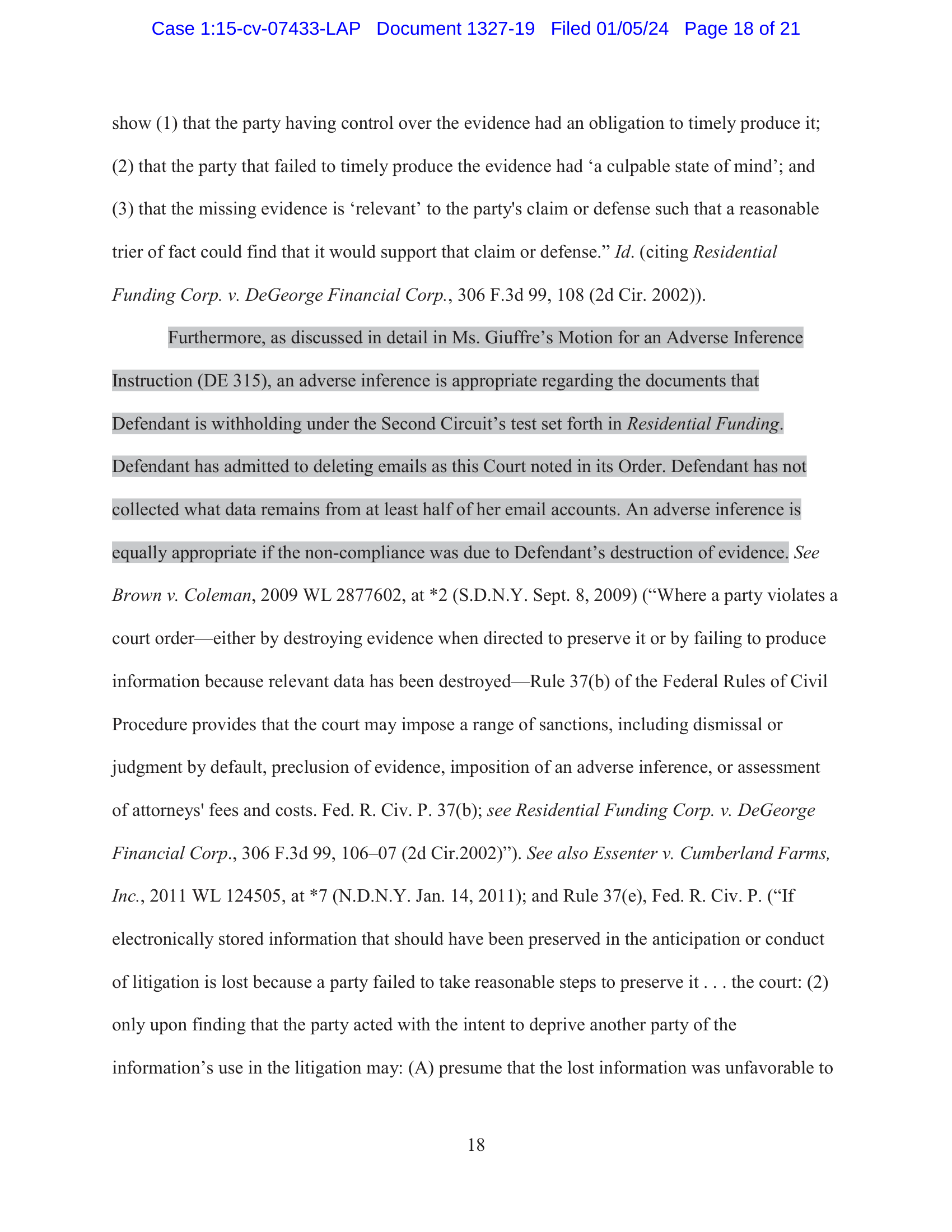
Furthermore, as discussed in detail in Ms. Giuffre’s Motion for an Adverse Inference
Instruction (DE 315), an adverse inference is appropriate regarding the documents that
Defendant is withholding under the Second Circuit’s test set forth in Residential Funding.
Defendant has admitted to deleting emails as this Court noted in its Order. Defendant has not
collected what data remains from at least half of her email accounts. An adverse inference is
equally appropriate if the non-compliance was due to Defendant’s destruction of evidence. See
Brown v. Coleman, 2009 WL 2877602, at *2 (S.D.N.Y. Sept. 8, 2009) (“Where a party violates a
court order—either by destroying evidence when directed to preserve it or by failing to produce
information because relevant data has been destroyed—Rule 37(b) of the Federal Rules of Civil
Procedure provides that the court may impose a range of sanctions, including dismissal or
judgment by default, preclusion of evidence, imposition of an adverse inference, or assessment
of attorneys' fees and costs. Fed. R. Civ. P. 37(b); see Residential Funding Corp. v. DeGeorge
Financial Corp., 306 F.3d 99, 106-07 (2d Cir.2002)”). See also Essenter v. Cumberland Farms,
Inc., 2011 WL 124505, at *7 (N.D.N.Y. Jan. 14, 2011); and Rule 37(e), Fed. R. Civ. P. (‘If
electronically stored information that should have been preserved in the anticipation or conduct
of litigation is lost because a party failed to take reasonable steps to preserve it. . . the court: (2)
only upon finding that the party acted with the intent to deprive another party of the
information’s use in the litigation may: (A) presume that the lost information was unfavorable to
18
Document Preview

Click to view full size
Extracted Information
Dates
Document Details
| Filename | Giuffre_Maxwell_Batch3_p00261.png |
| File Size | 319.4 KB |
| OCR Confidence | 94.7% |
| Has Readable Text | Yes |
| Text Length | 2,220 characters |
| Indexed | 2026-02-04 12:39:39.643426 |