HOUSE_OVERSIGHT_011027.jpg
Extracted Text (OCR)
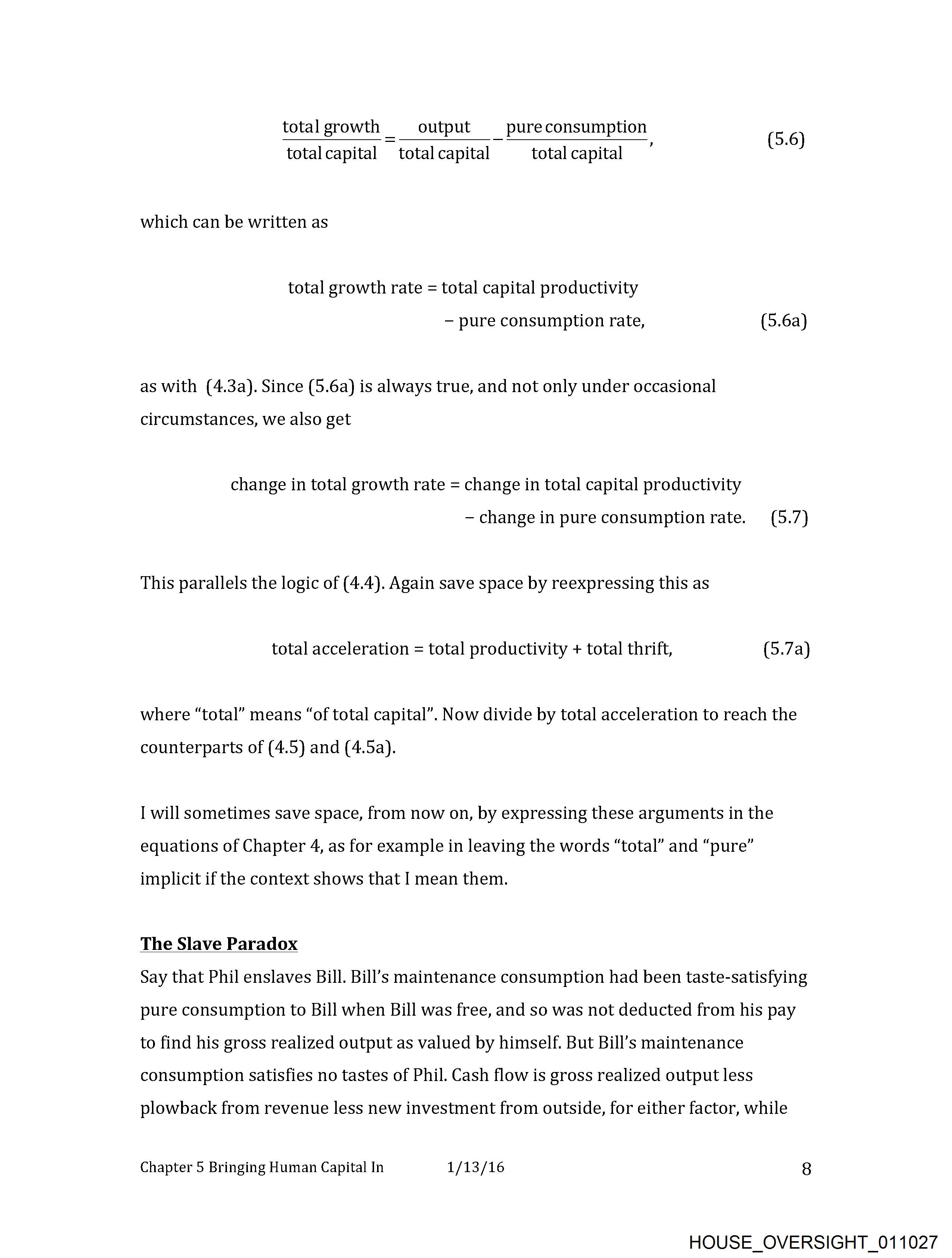
totalgrowth _— output pure consumption
= 5.6
totalcapital total capital total capital (9-6)
which can be written as
total growth rate = total capital productivity
— pure consumption rate, (5.6a)
as with (4.3a). Since (5.6a) is always true, and not only under occasional
circumstances, we also get
change in total growth rate = change in total capital productivity
— change in pureconsumption rate. (5.7)
This parallels the logic of (4.4). Again save space by reexpressing this as
total acceleration = total productivity + total thrift, (5.7a)
where “total” means “of total capital”. Now divide by total acceleration to reach the
counterparts of (4.5) and (4.5a).
I will sometimes save space, from now on, by expressing these arguments in the
equations of Chapter 4, as for example in leaving the words “total” and “pure”
implicit if the context shows that I mean them.
The Slave Paradox
Say that Phil enslaves Bill. Bill’s maintenance consumption had been taste-satisfying
pure consumption to Bill when Bill was free, and so was not deducted from his pay
to find his gross realized output as valued by himself. But Bill’s maintenance
consumption satisfies no tastes of Phil. Cash flow is gross realized output less
plowback from revenue less new investment from outside, for either factor, while
Chapter 5 Bringing Human Capital In 1/13/16 8
HOUSE_OVERSIGHT_011027
Document Preview

Click to view full size
Extracted Information
Dates
Document Details
| Filename | HOUSE_OVERSIGHT_011027.jpg |
| File Size | 0.0 KB |
| OCR Confidence | 85.0% |
| Has Readable Text | Yes |
| Text Length | 1,380 characters |
| Indexed | 2026-02-04T16:12:34.559195 |
Related Documents
Documents connected by shared names, same document type, or nearby in the archive.