HOUSE_OVERSIGHT_011882.jpg
Extracted Text (OCR)
/ BARAK / 125
Chapter Twenty-Five
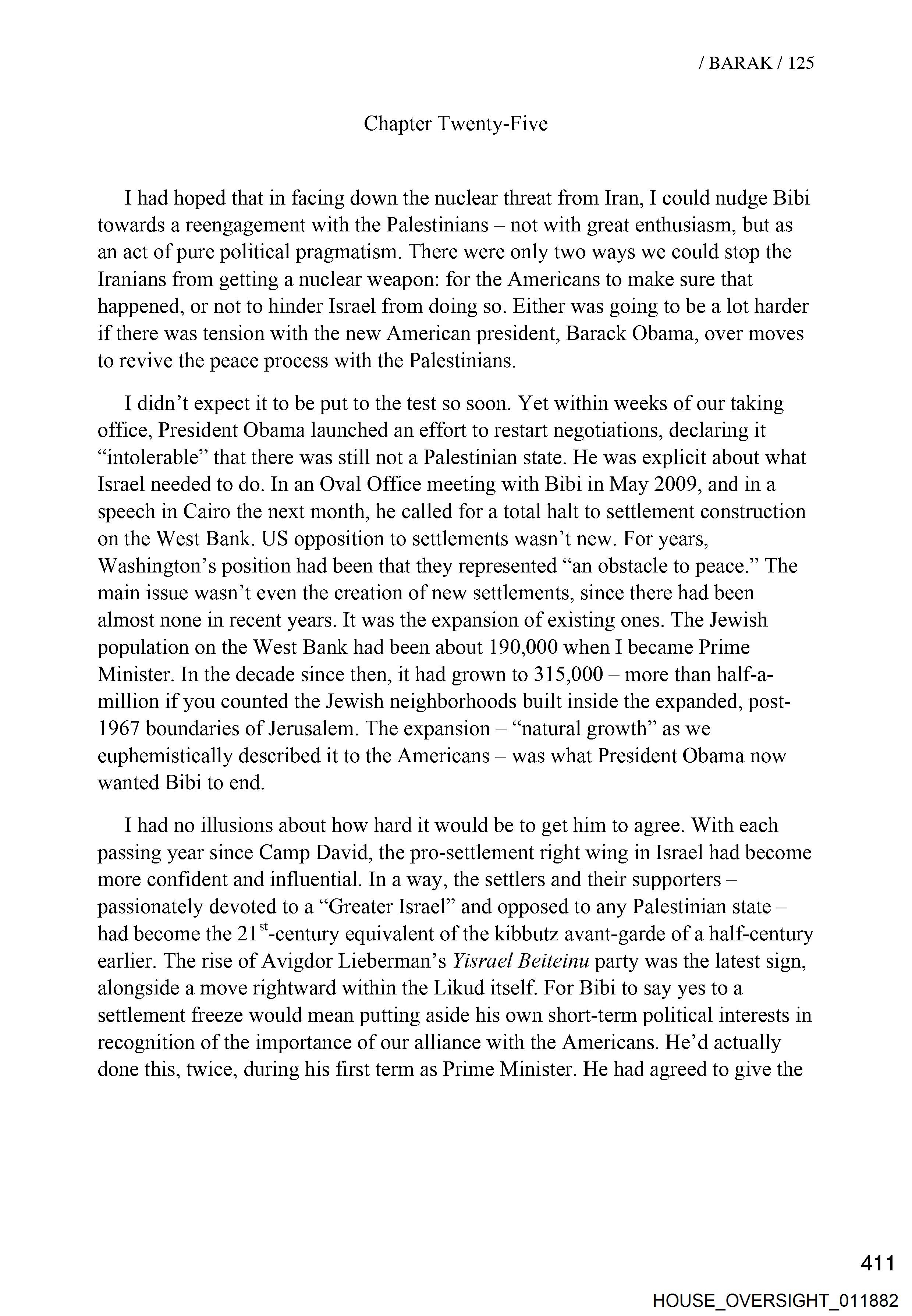
I had hoped that in facing down the nuclear threat from Iran, I could nudge Bibi
towards a reengagement with the Palestinians — not with great enthusiasm, but as
an act of pure political pragmatism. There were only two ways we could stop the
Iranians from getting a nuclear weapon: for the Americans to make sure that
happened, or not to hinder Israel from doing so. Either was going to be a lot harder
if there was tension with the new American president, Barack Obama, over moves
to revive the peace process with the Palestinians.
I didn’t expect it to be put to the test so soon. Yet within weeks of our taking
office, President Obama launched an effort to restart negotiations, declaring it
“intolerable” that there was still not a Palestinian state. He was explicit about what
Israel needed to do. In an Oval Office meeting with Bibi in May 2009, and in a
speech in Cairo the next month, he called for a total halt to settlement construction
on the West Bank. US opposition to settlements wasn’t new. For years,
Washington’s position had been that they represented “‘an obstacle to peace.” The
main issue wasn’t even the creation of new settlements, since there had been
almost none in recent years. It was the expansion of existing ones. The Jewish
population on the West Bank had been about 190,000 when I became Prime
Minister. In the decade since then, it had grown to 315,000 — more than half-a-
million if you counted the Jewish neighborhoods built inside the expanded, post-
1967 boundaries of Jerusalem. The expansion — “natural growth” as we
euphemistically described it to the Americans — was what President Obama now
wanted Bibi to end.
I had no illusions about how hard it would be to get him to agree. With each
passing year since Camp David, the pro-settlement right wing in Israel had become
more confident and influential. In a way, the settlers and their supporters —
passionately devoted to a “Greater Israel” and opposed to any Palestinian state —
had become the 21*-century equivalent of the kibbutz avant-garde of a half-century
earlier. The rise of Avigdor Lieberman’s Yisrael Beiteinu party was the latest sign,
alongside a move rightward within the Likud itself. For Bibi to say yes to a
settlement freeze would mean putting aside his own short-term political interests in
recognition of the importance of our alliance with the Americans. He’d actually
done this, twice, during his first term as Prime Minister. He had agreed to give the
A411
HOUSE_OVERSIGHT_011882
Document Preview

Click to view full size
Document Details
| Filename | HOUSE_OVERSIGHT_011882.jpg |
| File Size | 0.0 KB |
| OCR Confidence | 85.0% |
| Has Readable Text | Yes |
| Text Length | 2,534 characters |
| Indexed | 2026-02-04T16:15:13.735708 |