HOUSE_OVERSIGHT_013266.jpg
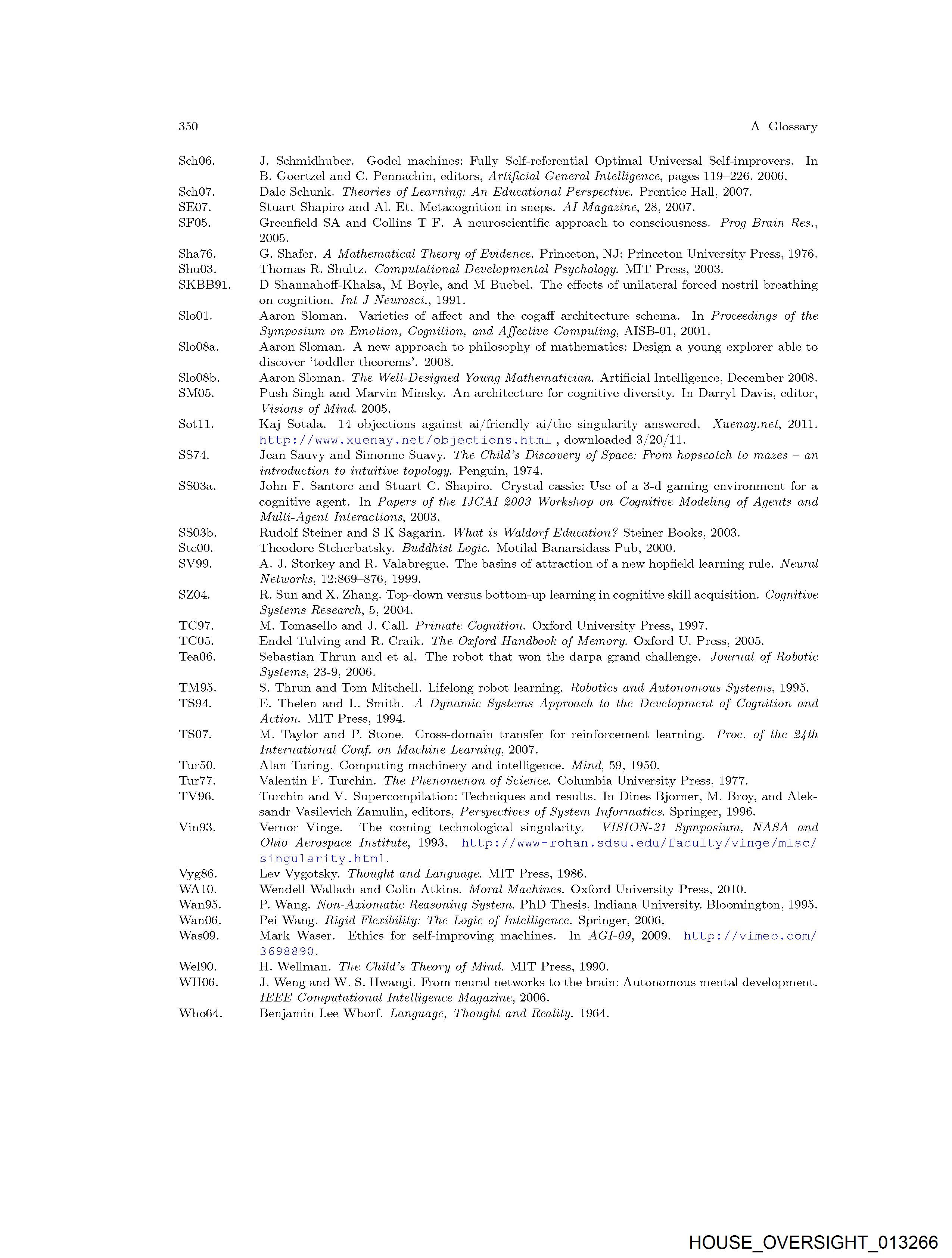
Extracted Text (OCR)
350 A Glossary
Sch06. J. Schmidhuber. Godel machines: Fully Self-referential Optimal Universal Self-improvers. In
B. Goertzel and C. Pennachin, editors, Artificial General Intelligence, pages 119-226. 2006.
SchO7. Dale Schunk. Theories of Learning: An Educational Perspective. Prentice Hall, 2007.
SEO7. Stuart Shapiro and Al. Et. Metacognition in sneps. AI Magazine, 28, 2007.
SF05. Greenfield SA and Collins T F. A neuroscientific approach to consciousness. Prog Brain Res.,
2005.
Sha76. G. Shafer. A Mathematical Theory of Evidence. Princeton, NJ: Princeton University Press, 1976.
Shu03. Thomas R. Shultz. Computational Developmental Psychology. MIT Press, 2003.
SKBB91. D Shannahoff-Khalsa, M Boyle, and M Buebel. The effects of unilateral forced nostril breathing
on cognition. Int J Neurosct., 1991.
Slo01. Aaron Sloman. Varieties of affect and the cogaff architecture schema. In Proceedings of the
Symposium on Emotion, Cognition, and Affective Computing, AISB-01, 2001.
Slo08a. Aaron Sloman. A new approach to philosophy of mathematics: Design a young explorer able to
discover toddler theorems’. 2008.
5lo08b. Aaron Sloman. The Well-Designed Young Mathematician. Artificial Intelligence, December 2008.
SMO5. Push Singh and Marvin Minsky. An architecture for cognitive diversity. In Darryl Davis, editor,
Visions of Mind. 2005.
Sot11. Kaj Sotala. 14 objections against ai/friendly ai/the singularity answered. Xuenay.net, 2011.
http://www. xuenay.net/objections.html , downloaded 3/20/11.
S874. Jean Sauvy and Simonne Suavy. The Child’s Discovery of Space: From hopscotch to mazes — an
introduction to intuitive topology. Penguin, 1974.
SS03a. John F. Santore and Stuart C. Shapiro. Crystal cassie: Use of a 3-d gaming environment for a
cognitive agent. In Papers of the [J/CAI 2003 Workshop on Cognitive Modeling of Agents and
Multi-Agent Interactions, 2003.
SS03b. Rudolf Steiner and S K Sagarin. What is Waldorf Education? Steiner Books, 2003.
Stc00. Theodore Stcherbatsky. Buddhist Logic. Motilal Banarsidass Pub, 2000.
SV99. A. J. Storkey and R. Valabregue. The basins of attraction of a new hopfield learning rule. Neural
Networks, 12:869-876, 1999.
SZ04. R. Sun and X. Zhang. Top-down versus bottom-up learning in cognitive skill acquisition. Cognitive
Systems Research, 5, 2004.
TC97. M. Tomasello and J. Call. Primate Cognition. Oxford University Press, 1997.
TCO5. Endel Tulving and R. Craik. The Oxford Handbook of Memory. Oxford U. Press, 2005.
Tead6. Sebastian Thrun and et al. The robot that won the darpa grand challenge. Journal of Robotic
Systems, 23-9, 2006.
TM95. S. Thrun and Tom Mitchell. Lifelong robot learning. Robotics and Autonomous Systems, 1995.
TsS94. E. Thelen and L. Smith. A Dynamic Systems Approach to the Development of Cognition and
Action. MIT Press, 1994.
TSO7. M. Taylor and P. Stone. Cross-domain transfer for reinforcement learning. Proc. of the 24th
International Conf. on Machine Learning, 2007.
Tur50. Alan Turing. Computing machinery and intelligence. Mind, 59, 1950.
Tur77. Valentin F. Turchin. The Phenomenon of Science. Columbia University Press, 1977.
TV96. Turchin and V. Supercompilation: Techniques and results. In Dines Bjorner, M. Broy, and Alek-
sandr Vasilevich Zamulin, editors, Perspectives of System Informatics. Springer, 1996.
Vin93. Vernor Vinge. The coming technological singularity. VISION-21 Symposium, NASA and
Ohio Aerospace Institute, 1993. http://www-rohan.sdsu.edu/faculty/vinge/misc/
singularity.html.
Vyg86. Lev Vygotsky. Thought and Language. MIT Press, 1986.
WA1O. Wendell Wallach and Colin Atkins. Moral Machines. Oxford University Press, 2010.
Wan95. P. Wang. Non-Aziomatic Reasoning System. PhD Thesis, Indiana University. Bloomington, 1995.
Wan06. Pei Wang. Rigid Flexibility: The Logic of Intelligence. Springer, 2006.
Was09. Mark Waser. Ethics for self-improving machines. In AGI-09, 2009. http://vimeo.com/
3698890.
Wel90. H. Wellman. The Child’s Theory of Mind. MIT Press, 1990.
WHO6. J. Weng and W. 5. Hwangi. From neural networks to the brain: Autonomous mental development.
IEEE Computational Intelligence Magazine, 2006.
Who64. Benjamin Lee Whorf. Language, Thought and Reality. 1964.
HOUSE_OVERSIGHT_013266
Document Preview

Click to view full size
Extracted Information
Dates
Document Details
| Filename | HOUSE_OVERSIGHT_013266.jpg |
| File Size | 0.0 KB |
| OCR Confidence | 85.0% |
| Has Readable Text | Yes |
| Text Length | 4,242 characters |
| Indexed | 2026-02-04T16:18:59.296624 |