HOUSE_OVERSIGHT_020847.jpg
Extracted Text (OCR)
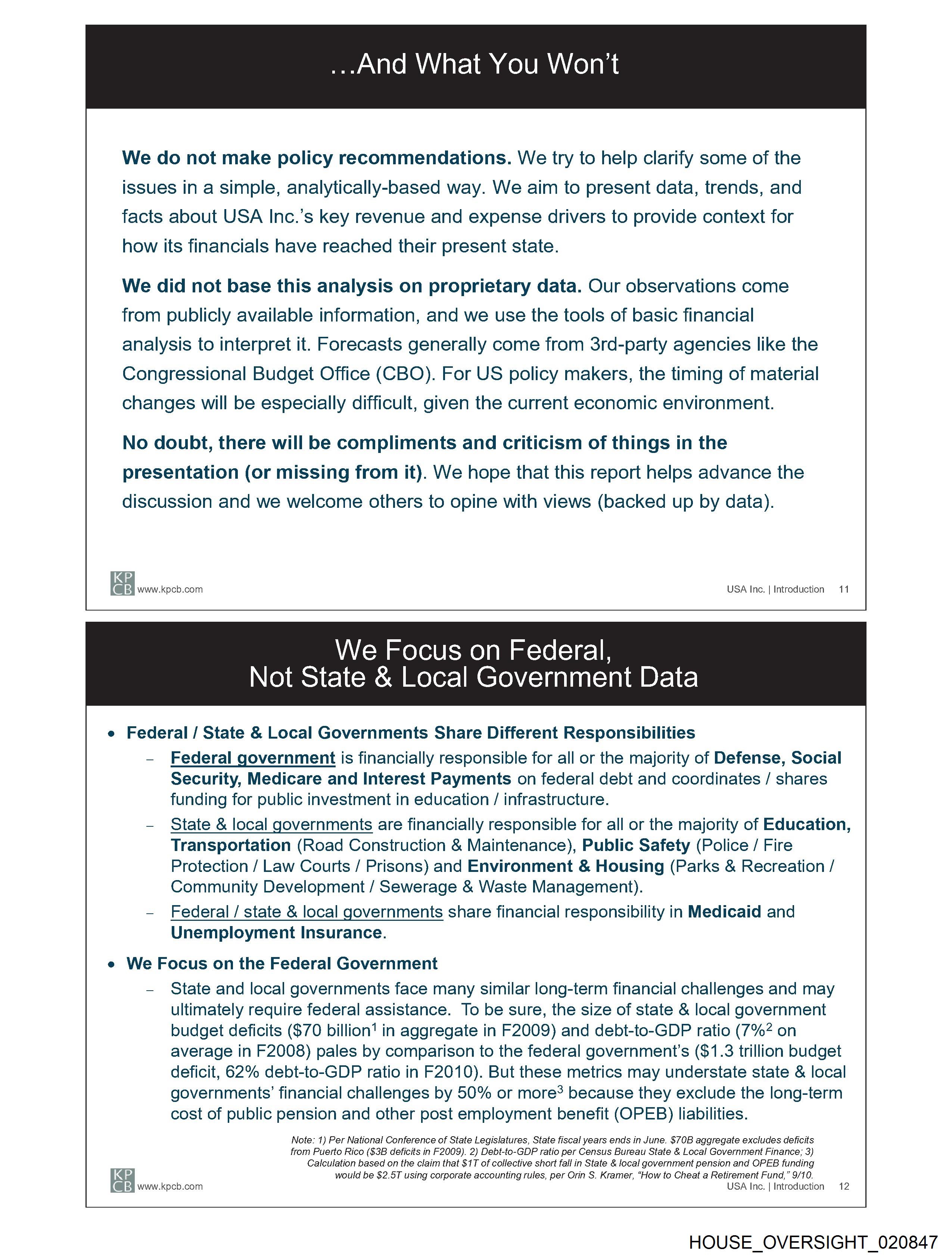
...And What You Won't
We do not make policy recommendations. We try to help clarify some of the
issues in a simple, analytically-based way. We aim to present data, trends, and
facts about USA Inc.’s key revenue and expense drivers to provide context for
how its financials have reached their present state.
We did not base this analysis on proprietary data. Our observations come
from publicly available information, and we use the tools of basic financial
analysis to interpret it. Forecasts generally come from 3rd-party agencies like the
Congressional Budget Office (CBO). For US policy makers, the timing of material
changes will be especially difficult, given the current economic environment.
No doubt, there will be compliments and criticism of things in the
presentation (or missing from it). We hope that this report helps advance the
discussion and we welcome others to opine with views (backed up by data).
KP
BSF owe poo com USA Inc. | Introduction 11
We Focus on Federal,
Not State & Local Government Data
e Federal / State & Local Governments Share Different Responsibilities
— Federal government is financially responsible for all or the majority of Defense, Social
Security, Medicare and Interest Payments on federal debt and coordinates / shares
funding for public investment in education / infrastructure.
— State & local governments are financially responsible for all or the majority of Education,
Transportation (Road Construction & Maintenance), Public Safety (Police / Fire
Protection / Law Courts / Prisons) and Environment & Housing (Parks & Recreation /
Community Development / Sewerage & Waste Management).
— Federal/ state & local governments share financial responsibility in Medicaid and
Unemployment Insurance.
e We Focus on the Federal Government
— State and local governments face many similar long-term financial challenges and may
ultimately require federal assistance. To be sure, the size of state & local government
budget deficits ($70 billion’ in aggregate in F2009) and debt-to-GDP ratio (7%? on
average in F2008) pales by comparison to the federal government's ($1.3 trillion budget
deficit, 62% debt-to-GDP ratio in F2010). But these metrics may understate state & local
governments’ financial challenges by 50% or more® because they exclude the long-term
cost of public pension and other post employment benefit (OPEB) liabilities.
Note: 1) Per National Conference of State Legislatures, State fiscal years ends in June. $70B aggregate excludes deficits
from Puerto Rico ($3B deficits in F2009). 2) Debt-to-GDP ratio per Census Bureau State & Local Government Finance; 3)
Calculation based on the claim that $1T of collective short fall in State & local government pension and OPEB funding
KP would be $2.5T using corporate accounting rules, per Orin S. Kramer, “How to Cheat a Retirement Fund,” 9/10.
(@ EB) www.kpcb.com USA Inc. | Introduction 12
HOUSE_OVERSIGHT_020847
Document Preview

Click to view full size
Document Details
| Filename | HOUSE_OVERSIGHT_020847.jpg |
| File Size | 0.0 KB |
| OCR Confidence | 85.0% |
| Has Readable Text | Yes |
| Text Length | 2,933 characters |
| Indexed | 2026-02-04T16:42:49.249691 |
Related Documents
Documents connected by shared names, same document type, or nearby in the archive.