HOUSE_OVERSIGHT_022354.jpg
Extracted Text (OCR)
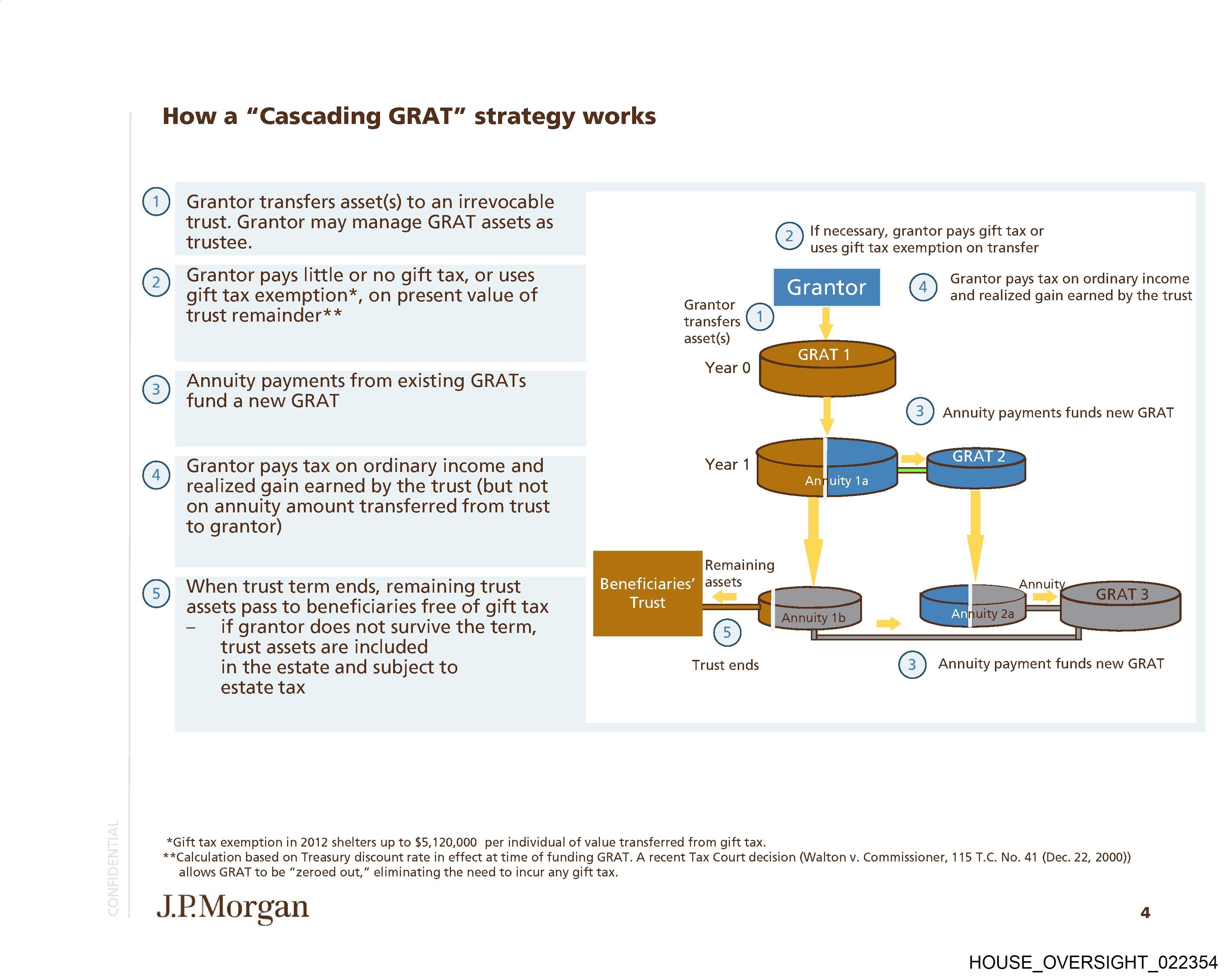
How a “Cascading GRAT” strategy works
G) Grantor transfers asset(s) to an irrevocable
trust. Grantor may manage GRAT assets as
trustee.
@ Grantor pays little or no gift tax, or uses
gift tax exemption*, on present value of
trust remainder**
Annuity payments from existing GRATs
fund a new GRAT
Grantor pays tax on ordinary income and
realized gain earned by the trust (but not
on annuity amount transferred from trust
to grantor)
©; When trust term ends, remaining trust
assets pass to beneficiaries free of gift tax
if grantor does not survive the term,
trust assets are included
in the estate and subject to
estate tax
Beneficiaries’ Estas
If necessary, grantor pays gift tax or
uses gift tax exemption on transfer
Grantor
Grantor
transfers G)
asset(s)
Year 0
Grantor pays tax on ordinary income
and realized gain earned by the trust
@) Annuity payments funds new GRAT
Year 1
Anguity 1a
Remaining
©
Trust ends
@) Annuity payment funds new GRAT
*Gift tax exemption in 2012 shelters up to $5,120,000 per individual of value transferred from gift tax.
**Calculation based on Treasury discount rate in effect at time of funding GRAT. A recent Tax Court decision (Walton v. Commissioner, 115 T.C. No. 41 (Dec. 22, 2000))
allows GRAT to be “zeroed out,” eliminating the need to incur any gift tax.
J.P Morgan
4
HOUSE_OVERSIGHT_022354
Document Preview

Click to view full size
Document Details
| Filename | HOUSE_OVERSIGHT_022354.jpg |
| File Size | 0.0 KB |
| OCR Confidence | 85.0% |
| Has Readable Text | Yes |
| Text Length | 1,351 characters |
| Indexed | 2026-02-04T16:47:43.777327 |