HOUSE_OVERSIGHT_023396.jpg
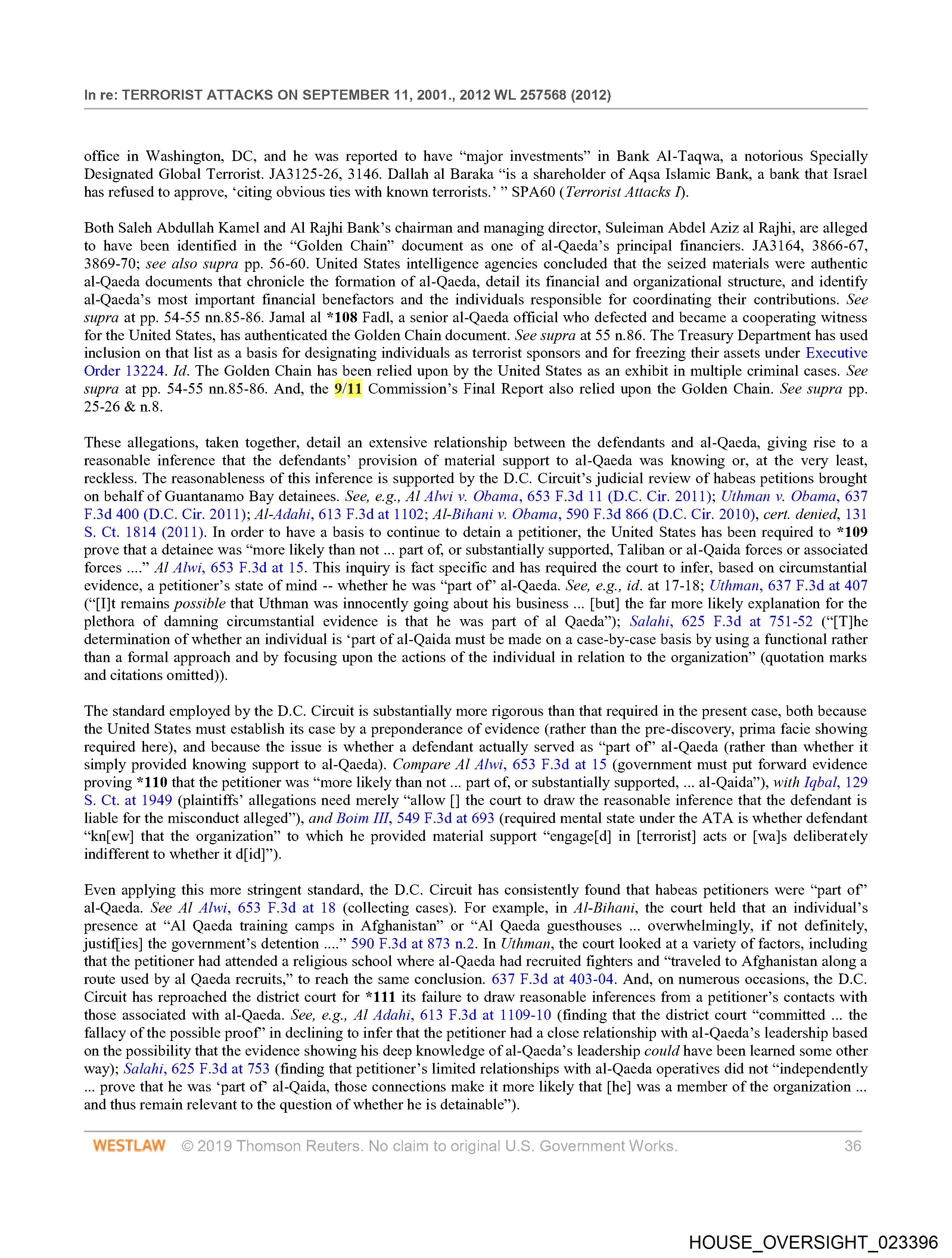
Extracted Text (OCR)
In re: TERRORIST ATTACKS ON SEPTEMBER 11, 2001., 2012 WL 257568 (2012)
office in Washington, DC, and he was reported to have “major investments” in Bank Al-Taqwa, a notorious Specially
Designated Global Terrorist. JA3125-26, 3146. Dallah al Baraka “is a shareholder of Aqsa Islamic Bank, a bank that Israel
has refused to approve, ‘citing obvious ties with known terrorists.’ ” SPA60 (Terrorist Attacks I).
Both Saleh Abdullah Kamel and Al Rajhi Bank’s chairman and managing director, Suleiman Abdel Aziz al Rajhi, are alleged
to have been identified in the “Golden Chain” document as one of al-Qaeda’s principal financiers. JA3164, 3866-67,
3869-70; see also supra pp. 56-60. United States intelligence agencies concluded that the seized materials were authentic
al-Qaeda documents that chronicle the formation of al-Qaeda, detail its financial and organizational structure, and identify
al-Qaeda’s most important financial benefactors and the individuals responsible for coordinating their contributions. See
supra at pp. 54-55 nn.85-86. Jamal al *108 Fadl, a senior al-Qaeda official who defected and became a cooperating witness
for the United States, has authenticated the Golden Chain document. See supra at 55 n.86. The Treasury Department has used.
inclusion on that list as a basis for designating individuals as terrorist sponsors and for freezing their assets under Executive
Order 13224. Id. The Golden Chain has been relied upon by the United States as an exhibit in multiple criminal cases. See
supra at pp. 54-55 nn.85-86. And, the 9/11 Commission’s Final Report also relied upon the Golden Chain. See supra pp.
25-26 &n.8.
These allegations, taken together, detail an extensive relationship between the defendants and al-Qaeda, giving rise to a
reasonable inference that the defendants’ provision of material support to al-Qaeda was knowing or, at the very least,
reckless. The reasonableness of this inference is supported by the D.C. Circuit’s judicial review of habeas petitions brought
on behalf of Guantanamo Bay detainees. See, e.g., Al Alwi v. Obama, 653 F.3d 11 (D.C. Cir. 2011); Uthman v. Obama, 637
F.3d 400 (D.C. Cir. 2011); Al-Adahi, 613 F.3d at 1102; Al-Bihani v. Obama, 590 F.3d 866 (D.C. Cir. 2010), cert. denied, 131
S. Ct. 1814 (2011). In order to have a basis to continue to detain a petitioner, the United States has been required to *109
prove that a detainee was “more likely than not ... part of, or substantially supported, Taliban or al-Qaida forces or associated
forces ....” Al Alwi, 653 F.3d at 15. This inquiry is fact specific and has required the court to infer, based on circumstantial
evidence, a petitioner’s state of mind -- whether he was “part of’ al-Qaeda. See, e.g., id. at 17-18; Uthman, 637 F.3d at 407
(“[I]t remains possible that Uthman was innocently going about his business ... [but] the far more likely explanation for the
plethora of damning circumstantial evidence is that he was part of al Qaeda”); Salahi, 625 F.3d at 751-52 (“[T]he
determination of whether an individual is ‘part of al-Qaida must be made on a case-by-case basis by using a functional rather
than a formal approach and by focusing upon the actions of the individual in relation to the organization” (quotation marks
and citations omitted)).
The standard employed by the D.C. Circuit is substantially more rigorous than that required in the present case, both because
the United States must establish its case by a preponderance of evidence (rather than the pre-discovery, prima facie showing
required here), and because the issue is whether a defendant actually served as “part of” al-Qaeda (rather than whether it
simply provided knowing support to al-Qaeda). Compare Al Alwi, 653 F.3d at 15 (government must put forward evidence
proving *110 that the petitioner was “more likely than not ... part of, or substantially supported, ... al-Qaida”), with Iqbal, 129
S. Ct. at 1949 (plaintiffs’ allegations need merely “allow [] the court to draw the reasonable inference that the defendant is
liable for the misconduct alleged”), and Boim IIT, 549 F.3d at 693 (required mental state under the ATA is whether defendant
“kn[ew] that the organization” to which he provided material support “engage[d] in [terrorist] acts or [wa]s deliberately
indifferent to whether it d[id]’”).
Even applying this more stringent standard, the D.C. Circuit has consistently found that habeas petitioners were “part of”
al-Qaeda. See Al Alwi, 653 F.3d at 18 (collecting cases). For example, in A/-Bihani, the court held that an individual’s
presence at “Al Qaeda training camps in Afghanistan” or “Al Qaeda guesthouses ... overwhelmingly, if not definitely,
justif[ies] the government’s detention ....” 590 F.3d at 873 n.2. In Uthman, the court looked at a variety of factors, including
that the petitioner had attended a religious school where al-Qaeda had recruited fighters and “traveled to Afghanistan along a
route used by al Qaeda recruits,” to reach the same conclusion. 637 F.3d at 403-04. And, on numerous occasions, the D.C.
Circuit has reproached the district court for *111 its failure to draw reasonable inferences from a petitioner’s contacts with
those associated with al-Qaeda. See, e.g., Al Adahi, 613 F.3d at 1109-10 (finding that the district court “committed ... the
fallacy of the possible proof” in declining to infer that the petitioner had a close relationship with al-Qaeda’s leadership based
on the possibility that the evidence showing his deep knowledge of al-Qaeda’s leadership could have been learned some other
way); Salahi, 625 F.3d at 753 (finding that petitioner’s limited relationships with al-Qaeda operatives did not “independently
... prove that he was ‘part of? al-Qaida, those connections make it more likely that [he] was a member of the organization ...
and thus remain relevant to the question of whether he is detainable”).
WESTLAW
HOUSE_OVERSIGHT_023396
Document Preview

Click to view full size
Extracted Information
Dates
Document Details
| Filename | HOUSE_OVERSIGHT_023396.jpg |
| File Size | 0.0 KB |
| OCR Confidence | 85.0% |
| Has Readable Text | Yes |
| Text Length | 5,915 characters |
| Indexed | 2026-02-04T16:50:51.141274 |