HOUSE_OVERSIGHT_024218.jpg
Extracted Text (OCR)
Global Utility White Paper CONFIDENTIAL
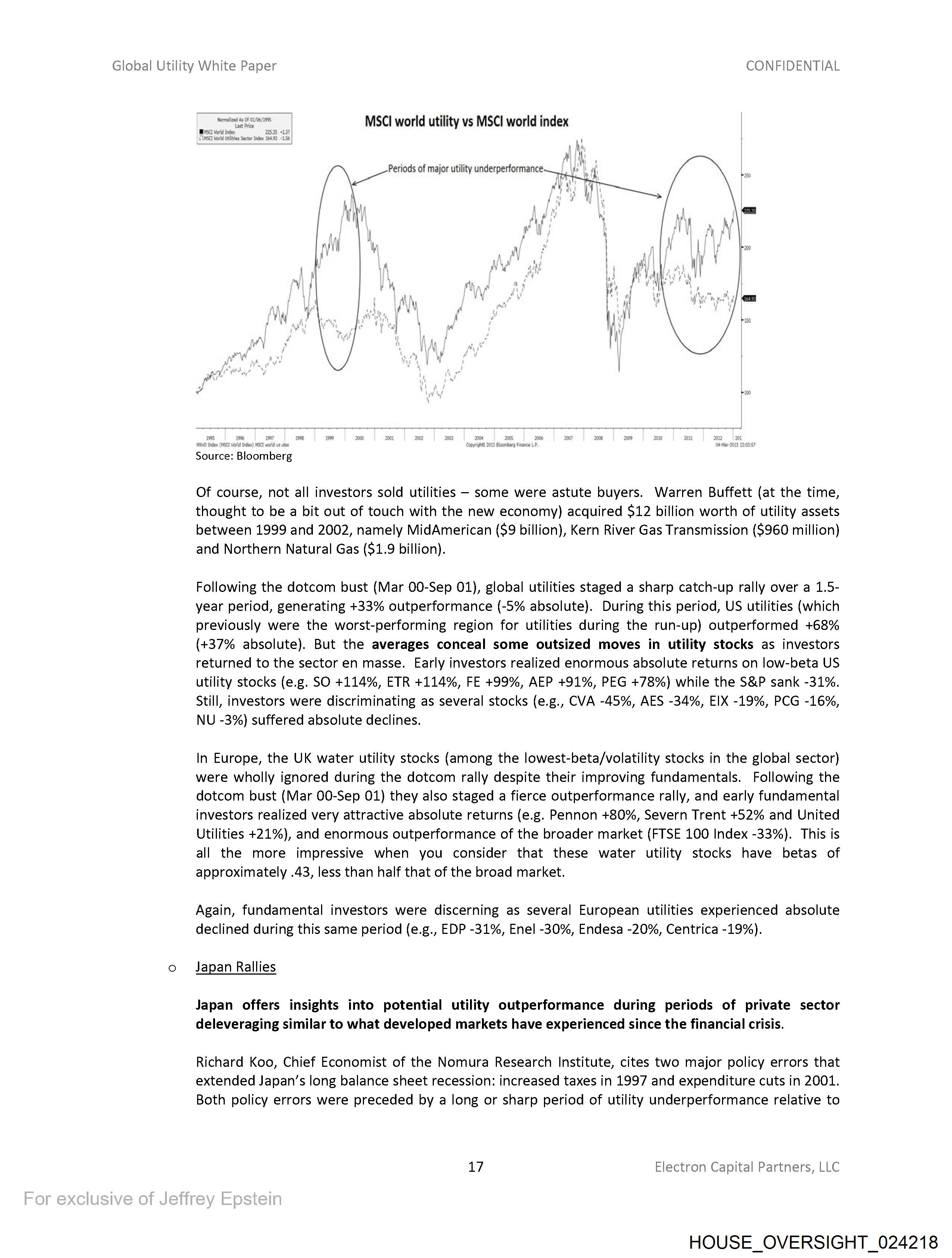
MSCI world utility vs MSCI world index
__———=
Source: Bloomberg
Of course, not all investors sold utilities - some were astute buyers. Warren Buffett (at the time,
thought to be a bit out of touch with the new economy) acquired $12 billion worth of utility assets
between 1999 and 2002, namely MidAmerican ($9 billion), Kern River Gas Transmission (S960 million)
and Northern Natural Gas ($1.9 billion).
Following the dotcom bust (Mar 00-Sep 01), global utilities staged a sharp catch-up rally over a 1.5-
year period, generating +33% outperformance (-5% absolute). During this period, US utilities (which
previously were the worst-performing region for utilities during the run-up) outperformed +68%
(+37% absolute). But the averages conceal some outsized moves in utility stocks as investors
returned to the sector en masse. Early investors realized enormous absolute returns on low-beta US
utility stocks (e.g. SO +114%, ETR +114%, FE +99%, AEP +91%, PEG +78%) while the S&P sank -31%.
Still, investors were discriminating as several stocks (e.g., CVA -45%, AES -34%, EIX -19%, PCG -16%,
NU -3%) suffered absolute declines.
In Europe, the UK water utility stocks (among the lowest-beta/volatility stocks in the global sector)
were wholly ignored during the dotcom rally despite their improving fundamentals. Following the
dotcom bust (Mar 00-Sep 01) they also staged a fierce outperformance rally, and early fundamental
investors realized very attractive absolute returns (e.g. Pennon +80%, Severn Trent +52% and United
Utilities +21%), and enormous outperformance of the broader market (FTSE 100 Index -33%). This is
all the more impressive when you consider that these water utility stocks have betas of
approximately .43, less than half that of the broad market.
Again, fundamental investors were discerning as several European utilities experienced absolute
declined during this same period (e.g., EDP -31%, Enel -30%, Endesa -20%, Centrica -19%).
o Japan Rallies
Japan offers insights into potential utility outperformance during periods of private sector
deleveraging similar to what developed markets have experienced since the financial crisis.
Richard Koo, Chief Economist of the Nomura Research Institute, cites two major policy errors that
extended Japan’s long balance sheet recession: increased taxes in 1997 and expenditure cuts in 2001.
Both policy errors were preceded by a long or sharp period of utility underperformance relative to
17 Electron Capital Partners, LLC
HOUSE_OVERSIGHT_024218
Document Preview

Click to view full size
Document Details
| Filename | HOUSE_OVERSIGHT_024218.jpg |
| File Size | 0.0 KB |
| OCR Confidence | 85.0% |
| Has Readable Text | Yes |
| Text Length | 2,563 characters |
| Indexed | 2026-02-04T16:53:32.524478 |