HOUSE_OVERSIGHT_024663.jpg
Extracted Text (OCR)
Or
A
“a
oa
cre
CHAPTER II Cannabis Science 101
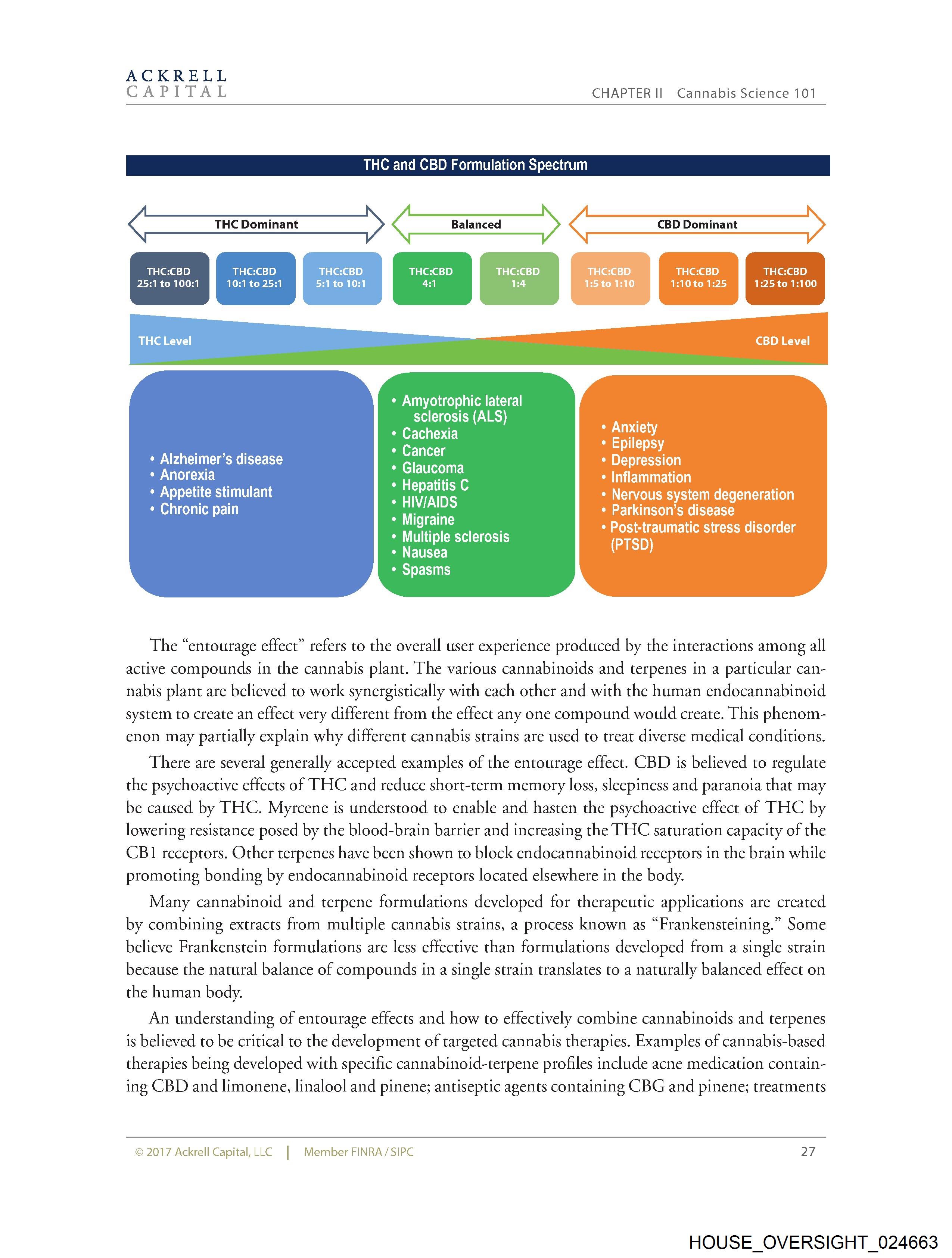
THC and CBD Formulation Spectrum
THC:CBD THC:CBD THC:CBD THC:CBD THC:CBD THC:CBD THC:CBD THC:CBD
25:1 to 100:1 10:1 to 25:1 5:1 to 10:1 4:1 1:4 1:5 to 1:10 1:10 to 1:25 1:25 to 1:100
THC Level CBD Level
¢ Amyotrophic lateral
sclerosis (ALS)
¢ Anxiety
* Epilepsy
* Alzheimer’s disease - * Depression
° Anorexia ; ane) * Inflammation
* Appetite stimulant ) ie ‘AIDS * Nervous system degeneration
* Chronic pain ¢ Parkinson’s disease
: Minte be : ¢ Post-traumatic stress disorder
¢ Multiple sclerosis (PTSD)
¢ Nausea
¢ Spasms
* Cachexia
¢ Cancer
The “entourage effect” refers to the overall user experience produced by the interactions among all
active compounds in the cannabis plant. The various cannabinoids and terpenes in a particular can-
nabis plant are believed to work synergistically with each other and with the human endocannabinoid
system to create an effect very different from the effect any one compound would create. This phenom-
enon may partially explain why different cannabis strains are used to treat diverse medical conditions.
There are several generally accepted examples of the entourage effect. CBD is believed to regulate
the psychoactive effects of THC and reduce short-term memory loss, sleepiness and paranoia that may
be caused by THC. Myrcene is understood to enable and hasten the psychoactive effect of THC by
lowering resistance posed by the blood-brain barrier and increasing the THC saturation capacity of the
CB1 receptors. Other terpenes have been shown to block endocannabinoid receptors in the brain while
promoting bonding by endocannabinoid receptors located elsewhere in the body.
Many cannabinoid and terpene formulations developed for therapeutic applications are created
by combining extracts from multiple cannabis strains, a process known as “Frankensteining.” Some
believe Frankenstein formulations are less effective than formulations developed from a single strain
because the natural balance of compounds in a single strain translates to a naturally balanced effect on
the human body.
An understanding of entourage effects and how to effectively combine cannabinoids and terpenes
is believed to be critical to the development of targeted cannabis therapies. Examples of cannabis-based
therapies being developed with specific cannabinoid-terpene profiles include acne medication contain-
ing CBD and limonene, linalool and pinene; antiseptic agents containing CBG and pinene; treatments
© 2017 Ackrell Capital, LLC | Member FINRA/SIPC 27
HOUSE_OVERSIGHT_024663
Document Preview

Click to view full size
Document Details
| Filename | HOUSE_OVERSIGHT_024663.jpg |
| File Size | 0.0 KB |
| OCR Confidence | 85.0% |
| Has Readable Text | Yes |
| Text Length | 2,577 characters |
| Indexed | 2026-02-04T16:54:59.738355 |
Related Documents
Documents connected by shared names, same document type, or nearby in the archive.