HOUSE_OVERSIGHT_025012.jpg
Extracted Text (OCR)
16
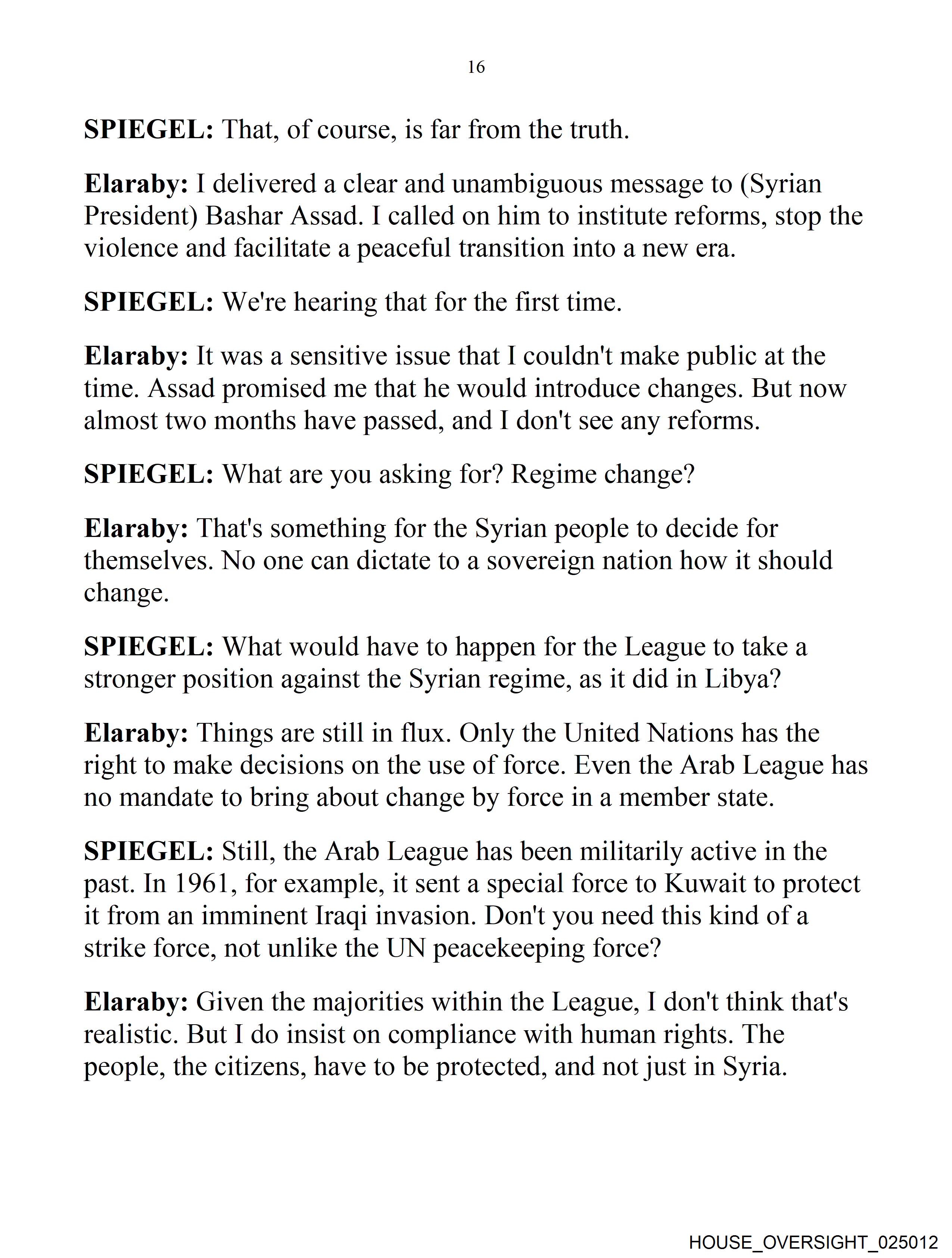
SPIEGEL: That, of course, is far from the truth.
Elaraby: | delivered a clear and unambiguous message to (Syrian
President) Bashar Assad. I called on him to institute reforms, stop the
violence and facilitate a peaceful transition into a new era.
SPIEGEL: We're hearing that for the first time.
Elaraby: It was a sensitive issue that I couldn't make public at the
time. Assad promised me that he would introduce changes. But now
almost two months have passed, and I don't see any reforms.
SPIEGEL: What are you asking for? Regime change?
Elaraby: That's something for the Syrian people to decide for
themselves. No one can dictate to a sovereign nation how it should
change.
SPIEGEL: What would have to happen for the League to take a
stronger position against the Syrian regime, as it did in Libya?
Elaraby: Things are still in flux. Only the United Nations has the
right to make decisions on the use of force. Even the Arab League has
no mandate to bring about change by force in a member state.
SPIEGEL: Still, the Arab League has been militarily active in the
past. In 1961, for example, it sent a special force to Kuwait to protect
it from an imminent Iraqi invasion. Don't you need this kind of a
strike force, not unlike the UN peacekeeping force?
Elaraby: Given the majorities within the League, I don't think that's
realistic. But I do insist on compliance with human rights. The
people, the citizens, have to be protected, and not just in Syria.
HOUSE_OVERSIGHT_025012
Document Preview

Click to view full size
Document Details
| Filename | HOUSE_OVERSIGHT_025012.jpg |
| File Size | 0.0 KB |
| OCR Confidence | 85.0% |
| Has Readable Text | Yes |
| Text Length | 1,493 characters |
| Indexed | 2026-02-04T16:55:57.300980 |
Related Documents
Documents connected by shared names, same document type, or nearby in the archive.