HOUSE_OVERSIGHT_025267.jpg
Extracted Text (OCR)
Asian equities (ex-Japan)
MSCI Asia ex-Japan (24 Oct): 518 (last publication: 510)
UBS view MSCI Asia ex-Japan (6-month target): 545
¢ China released a set of positive data for September. While the headline 3Q GDP number only met
expectations at +7.4% YoY (consensus +7.4%, prior +7.6%), the higher frequency data was better.
Industrial production of +9.2% YoY (consensus +9.0%, prior +8.9%), retail sales of +14.2% YoY
(consensus +13.2%, prior +13.2%), and fixed asset investment of +20.5% (+20.2% consensus, prior
+20.2%) all came in higher.
Chinese H-Shares are up almost 10% in the last month, while the S&P 500 is within 0.4 index points of
where it was a month ago. Valuations of MSCI China remain extremely attractive as the market
continues to price in a hard landing scenario, although sentiment is clearly turning. In India, the
government has proposed several key economic reforms, but there are implementation risks and
consensus GDP forecasts still have downside risk, while Indonesia's economic momentum is on track.
We expect 12.8% earnings-per-share growth over 12 months for the MSCI Asia ex-Japan. It trades on
11.0x 12-m forward earnings and 1.6x price-to-book. We expect a stable earnings multiple in the next six
months. Economic growth should stabilize and earnings downgrades come to an end toward the end of
2012.
A Positive scenario MSCI Asia ex-Japan (6-month target): 670
e More supportive monetary and fiscal policy, stable inflation, sustained domestic demand growth, and an
improved global growth outlook lead to a better earnings outlook. In such a scenario, we expect
earnings growth of 15% and a trailing P/E of about 15.0x.
& Negative scenario MSCI Asia ex-Japan (6-month target): 400
e A hard landing in China with a global recession leads to negative earnings revisions for 2012. In this
scenario, Asia ex-Japan could trade down to about 10.5x realized earnings.
What we're watching Why it matters
Politics Leadership in China is set to change, resulting in a newly defined future
economic policy. The US Presidential elections have implications on the
outcome of the Fiscal Cliff. Key dates: Nov 6, 57" US Presidential
Elections; Nov 8, 18" Communist Party Congress
Policy responses Some other countries in the region have near-term macroeconomic issues due
to fiscal and current account deficits, as well as hiccups in market and economic
reforms. Policy responses often come on an ad-hoc basis.
2 UBS
Recommendations
Tactical (6 months)
° The Fed's implementation of QE3 provides
support to Asia ex-Japan equities. In
conjunction with improving growth
prospects we see good near term upside.
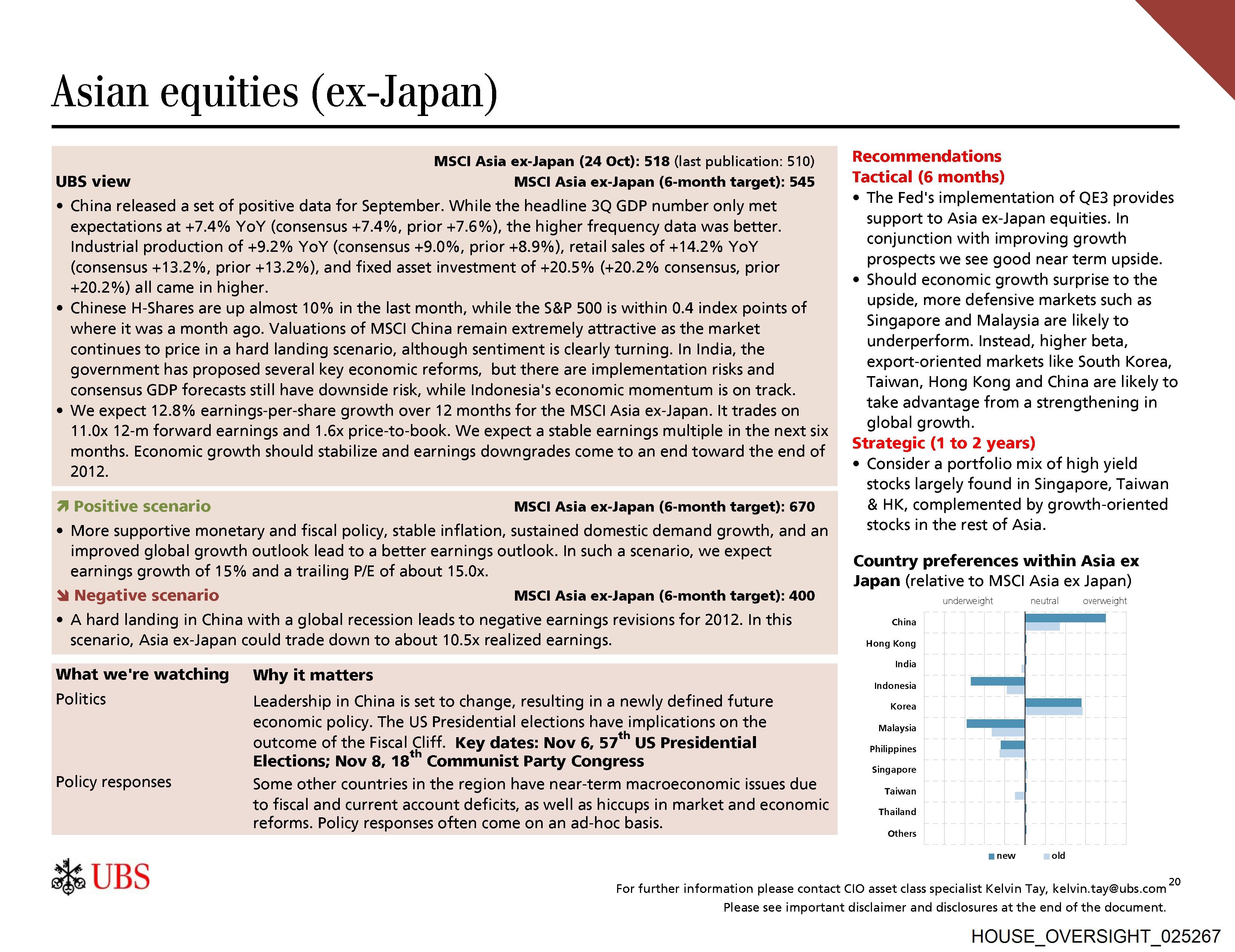
Should economic growth surprise to the
upside, more defensive markets such as
Singapore and Malaysia are likely to
underperform. Instead, higher beta,
export-oriented markets like South Korea,
Taiwan, Hong Kong and China are likely to
take advantage from a strengthening in
global growth.
Strategic (1 to 2 years)
¢ Consider a portfolio mix of high yield
stocks largely found in Singapore, Taiwan
& HK, complemented by growth-oriented
stocks in the rest of Asia.
Country preferences within Asia ex
Japan (relative to MSCI Asia ex Japan)
underweight neutral overweight
China —————]
Hong Kong
India
Indonesia |
Korea a
Malaysia Saaz
Philippines fz
Singapore
Taiwan
Thailand
Others
Bnew old
For further information please contact ClO asset class specialist Kelvin Tay, kelvin.tay@ubs.com 20
Please see important disclaimer and disclosures at the end of the document.
HOUSE_OVERSIGHT_025267
Document Preview

Click to view full size
Extracted Information
Email Addresses
Document Details
| Filename | HOUSE_OVERSIGHT_025267.jpg |
| File Size | 0.0 KB |
| OCR Confidence | 85.0% |
| Has Readable Text | Yes |
| Text Length | 3,551 characters |
| Indexed | 2026-02-04T16:56:39.481645 |