HOUSE_OVERSIGHT_025287.jpg
Extracted Text (OCR)
Hedge funds
UBS View Prefer Relative-value and Event-driven
° We expect hedge funds (HF) to offer positive asymmetric return characteristics due to active risk
management and stop-loss strategies. On the active risk side of the equation, we have seen lower gross
exposure and net-market exposure within the overall hedge funds group, with traders being cautiously
positioned. With systemic risk at bay, we favor relative-value (RV ) and event-driven (ED) strategies.
¢ The inherent hedging in relative value is appealing. Credit relative-value managers should perform well
in this environment of higher fixed-income volatility and increasing pricing anomalies created by central
bank interventions and limited competition.
¢ While ED managers share some of the performance drivers, idiosyncratic bets reduce the correlation to
markets. The real reason to own this strategy, however, is the potential for outsized returns in distressed,
high-yield, and other credit investments as the Eurozone crisis plays out.
A Positive scenario Prefer Equity long-short
e Reduced uncertainty (e.g. resolution in Europe) lowers equities’ correlation and volatility. This helps
bottom-up fundamental analysis and equity long/short managers the mast. Also, CEOs will likely make
more corporate transactions that can be monetized by event-driven managers, and a clearer
macroeconomic environment with more persistent trends would support CTA managers.
‘Negative scenario Prefer Trading (Global Macro + CTA)
° So far this year, the market has remained plagued by short-term reversals, due to central banks’
intervention and stimulus effects, an obstacle for trend-following managers. Still, if the European
deleveraging (or fiscal cliff, China hard landing) is unmanaged, this could threaten risky assets. Trading
can do well if such a scenario unfolds.
Note: Scenarios refer to global economic scenarios (see slide 7).
What we're Why it matters
watching
Global equity direction/
economic cycle
The outlook for global equities is an important HF performance driver. The
economic cycle impacts the strategies differently.
Correlation Correlation is an important performance/alpha driver for equity long/short, the
largest HF strategy by assets under management.
Leverage Gross and net leverage are key to monitoring risk.
Volatility The direction influences certain HF strategies (e.g. convertible arbitrage).
Liquidity Important in particular for large, less nimble HFs, it enables them to enter and
exit their strategies.
Regulation Volcker rule, USCITS III/IV
2 UBS
Recommendations
Strategic (1 to 2 years)
Recommendation: Active risk
management is instrumental for capital
preservation during adverse market
conditions. At the moment, we therefore
favor relative-value and event-driven
strategies, since they are less correlated to
equity markets and other risky assets than
trading.
Value proposition: Hedge funds should
achieve robust performance over an
extended horizon, while displaying
limited volatility vis-a-vis equities and
other risky assets. Hedge funds try to
minimize downside losses in adverse
market conditions (e.g. active risk
management), which plays a crucial role in
wealth appreciation. Similarly, hedge fund
managers attempt to capture most of the
upside of risky assets owning to valid
value preposition.
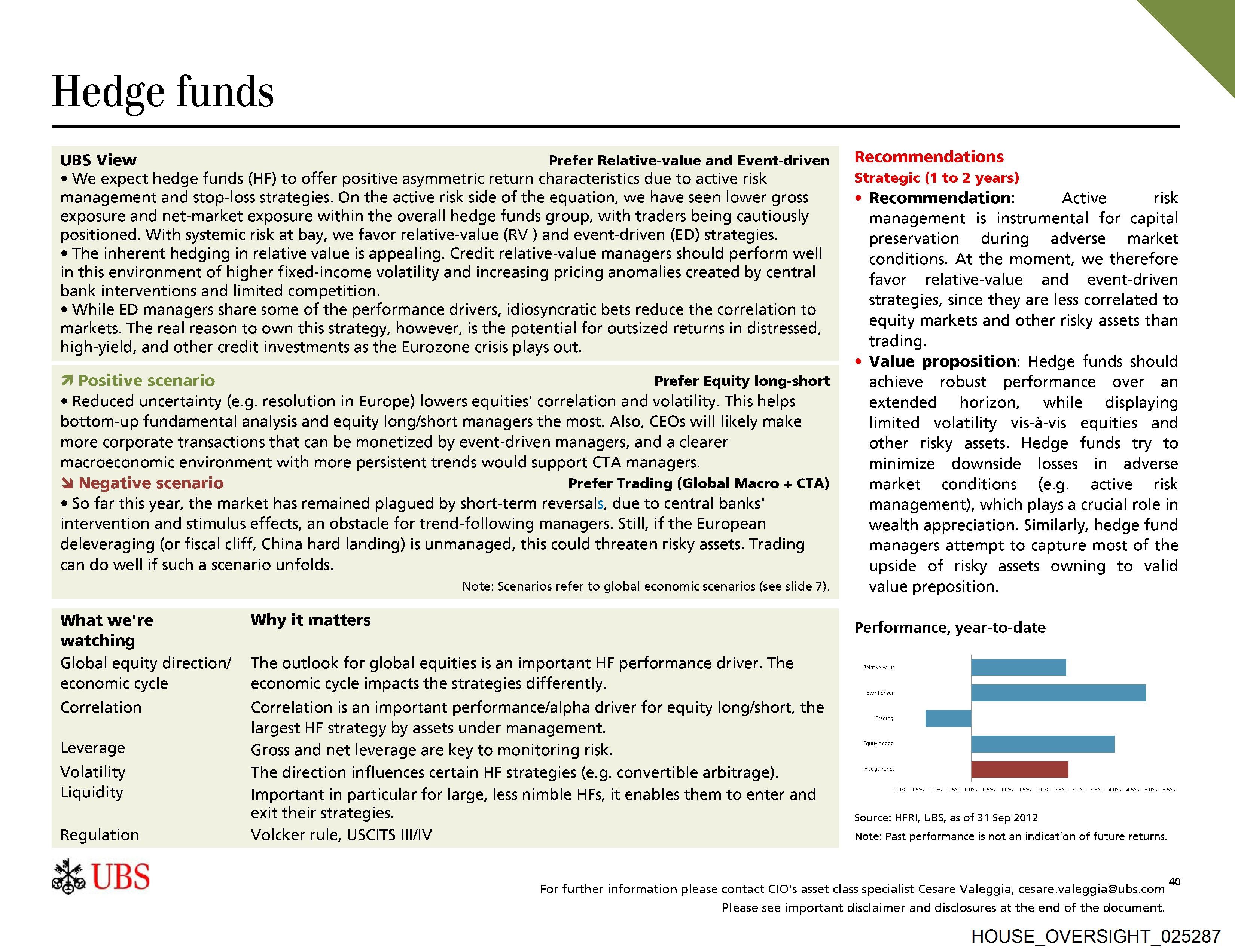
Performance, year-to-date
Relative value
Equity hedge
Hedge Funds
-2.0% -15% -1.0% 0.5% 0.0% 05% 1.0% 15% 20% 25% 30% 35% 4.0% 4.5% 5.0% 5.5%
Source: HFRI, UBS, as of 31 Sep 2012
Note: Past performance is not an indication of future returns.
For further information please contact ClO's asset class specialist Cesare Valeggia, cesare.valeggia@ubs.com
Please see important disclaimer and disclosures at the end of the document.
HOUSE_OVERSIGHT_025287
Document Preview

Click to view full size
Extracted Information
Email Addresses
Document Details
| Filename | HOUSE_OVERSIGHT_025287.jpg |
| File Size | 0.0 KB |
| OCR Confidence | 85.0% |
| Has Readable Text | Yes |
| Text Length | 3,790 characters |
| Indexed | 2026-02-04T16:56:43.601637 |