HOUSE_OVERSIGHT_026699.jpg
Extracted Text (OCR)
Sovereigns see potential in Indian private markets
Despite tactical switching between developed
markets, increasing investment into emerging markets
remains a long-term strategic objective for many
sovereigns (as stated in our 2016 report). Stock
markets have relatively small coverage of emerging
market economies, driving greater emphasis on
illiquid real asset categories. In fact, many sovereigns
use infrastructure deals to manage near-term macro
and geopolitical risk, as outlined in our 2015 study.
However, challenging placement dynamics and
uncertainty over commodity prices mean sovereigns
are being more selective in their emerging market
investments, focusing on the identification of high-
growth markets.
While many emerging markets have struggled with
slow commodity price recovery and political instability,
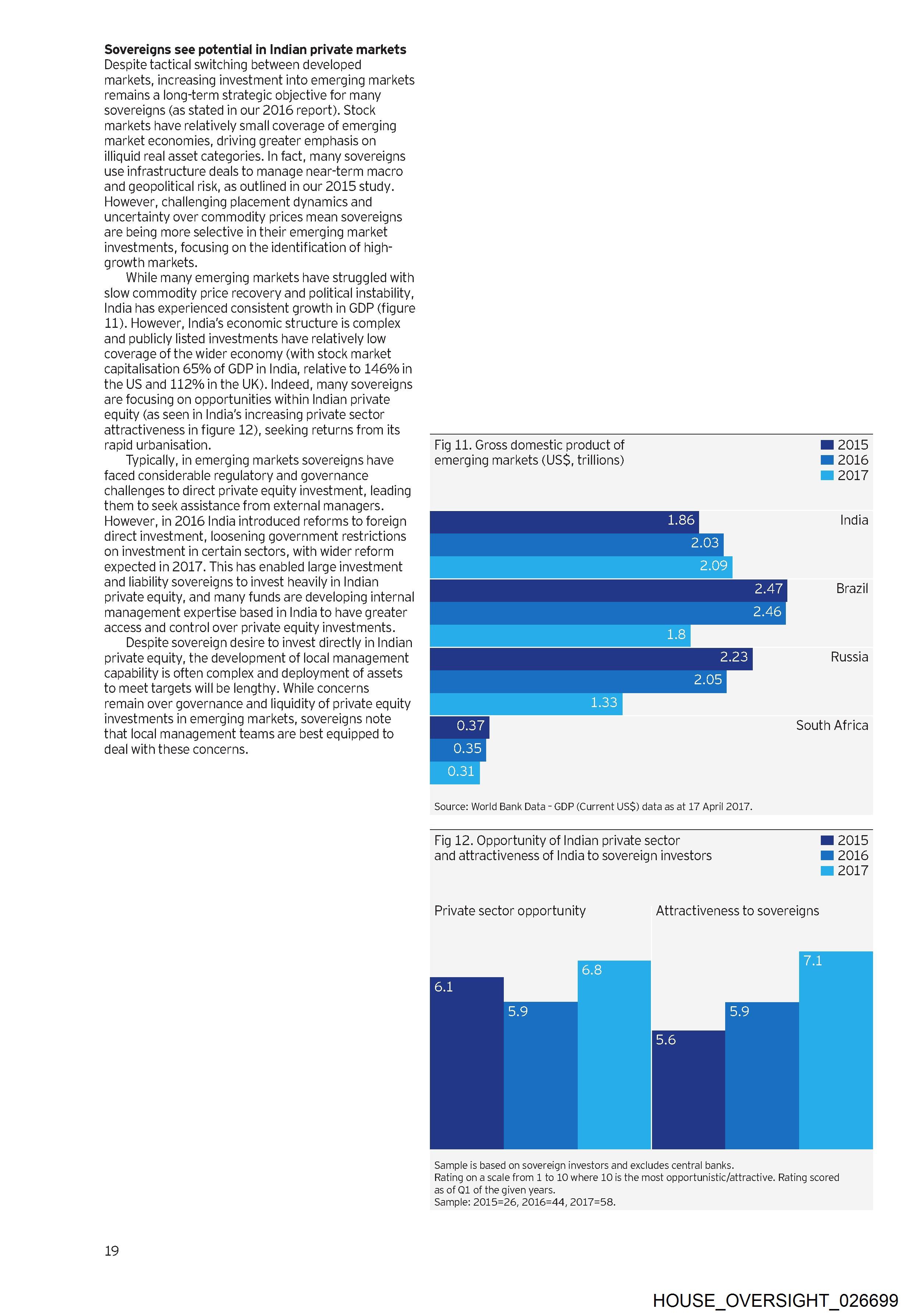
India has experienced consistent growth in GDP (figure
11). However, India’s economic structure is complex
and publicly listed investments have relatively low
coverage of the wider economy (with stock market
capitalisation 65% of GDP in India, relative to 146% in
the US and 112% in the Uk). Indeed, many sovereigns
are focusing on opportunities within Indian private
equity (as seen in India’s increasing private sector
attractiveness in figure 12), seeking returns from its
rapid urbanisation.
Typically, in emerging markets sovereigns have
faced considerable regulatory and governance
challenges to direct private equity investment, leading
them to seek assistance from external managers.
However, in 2016 India introduced reforms to foreign
direct investment, loosening government restrictions
on investment in certain sectors, with wider reform
expected in 2017. This has enabled large investment
and liability sovereigns to invest heavily in Indian
private equity, and many funds are developing internal
management expertise based in India to have greater
access and control over private equity investments.
Despite sovereign desire to invest directly in Indian
private equity, the development of local management
capability is often complex and deployment of assets
to meet targets will be lengthy. While concerns
remain over governance and liquidity of private equity
investments in emerging markets, sovereigns note
that local management teams are best equipped to
deal with these concerns.
19
Fig 11. Gross domestic product of mM 2015
emerging markets (USS, trillions) @ 2016
@ 2017
India
Brazil
Russia
South Africa
O31
Source: World Bank Data - GDP (Current USS) data as at 17 April 2017.
Fig 12. Opportunity of Indian private sector M@ 2015
and attractiveness of India to sovereign investors @ 2016
m 2017
Private sector opportunity Attractiveness to sovereigns
Sample is based on sovereign investors and excludes central banks.
Rating on a scale from 1 to 10 where 10 is the most opportunistic/attractive. Rating scored
as of Q1 of the given years.
Sample: 2015=26, 2016=44, 2017=58.
HOUSE_OVERSIGHT_026699
Document Preview

Click to view full size
Document Details
| Filename | HOUSE_OVERSIGHT_026699.jpg |
| File Size | 0.0 KB |
| OCR Confidence | 85.0% |
| Has Readable Text | Yes |
| Text Length | 2,955 characters |
| Indexed | 2026-02-04T16:59:41.359857 |