HOUSE_OVERSIGHT_030825.jpg
Extracted Text (OCR)
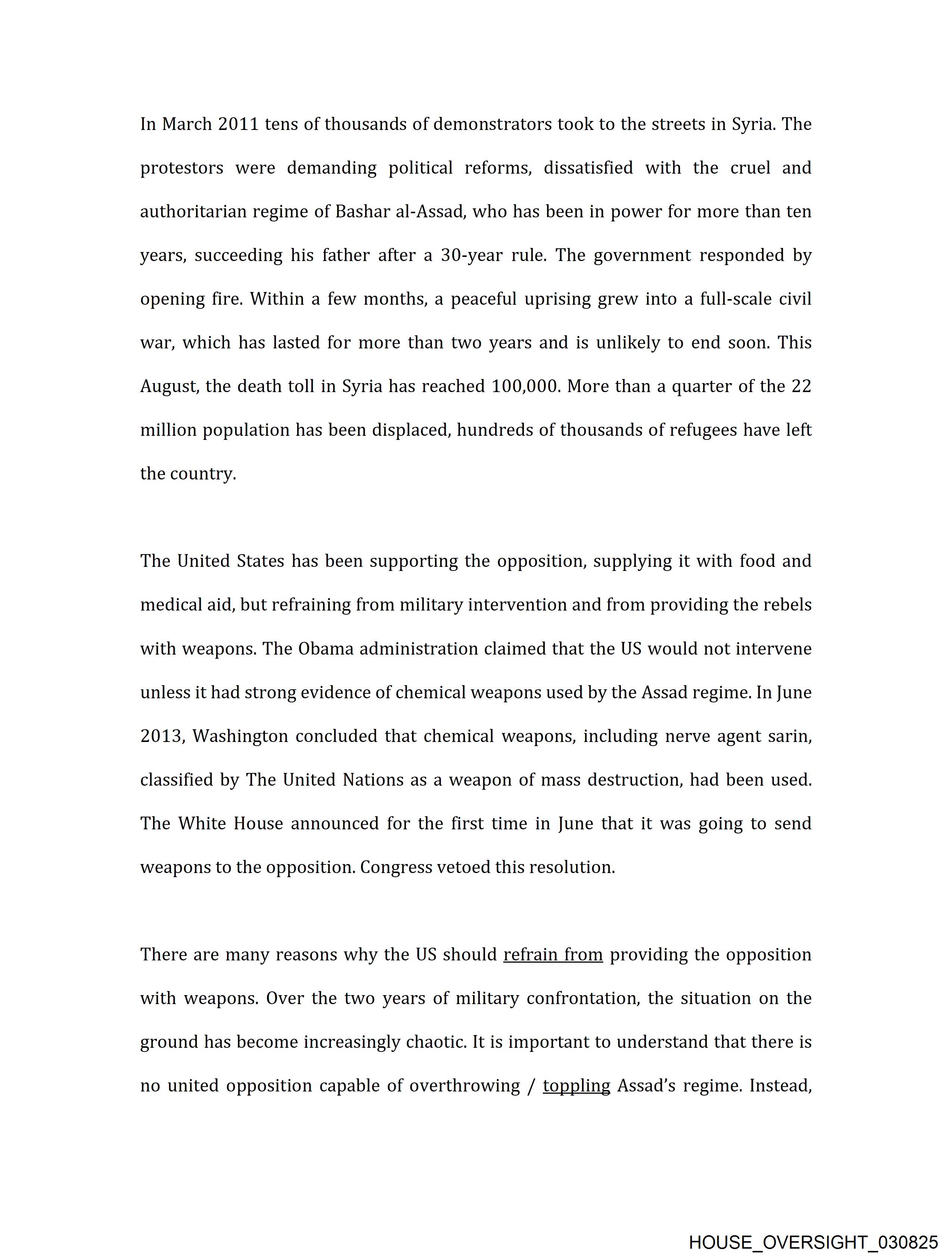
In March 2011 tens of thousands of demonstrators took to the streets in Syria. The
protestors were demanding political reforms, dissatisfied with the cruel and
authoritarian regime of Bashar al-Assad, who has been in power for more than ten
years, succeeding his father after a 30-year rule. The government responded by
opening fire. Within a few months, a peaceful uprising grew into a full-scale civil
war, which has lasted for more than two years and is unlikely to end soon. This
August, the death toll in Syria has reached 100,000. More than a quarter of the 22
million population has been displaced, hundreds of thousands of refugees have left
the country.
The United States has been supporting the opposition, supplying it with food and
medical aid, but refraining from military intervention and from providing the rebels
with weapons. The Obama administration claimed that the US would not intervene
unless it had strong evidence of chemical weapons used by the Assad regime. In June
2013, Washington concluded that chemical weapons, including nerve agent sarin,
classified by The United Nations as a weapon of mass destruction, had been used.
The White House announced for the first time in June that it was going to send
weapons to the opposition. Congress vetoed this resolution.
There are many reasons why the US should refrain from providing the opposition
with weapons. Over the two years of military confrontation, the situation on the
ground has become increasingly chaotic. It is important to understand that there is
no united opposition capable of overthrowing / toppling Assad’s regime. Instead,
HOUSE_OVERSIGHT_030825
Document Preview

Click to view full size
Document Details
| Filename | HOUSE_OVERSIGHT_030825.jpg |
| File Size | 0.0 KB |
| OCR Confidence | 85.0% |
| Has Readable Text | Yes |
| Text Length | 1,645 characters |
| Indexed | 2026-02-04T17:08:58.412388 |