DOJ-OGR-00008599.jpg
Extracted Text (OCR)
10
11
12
13
14
15
16
17
18
19
20
21
22
23
24
Case 1:20-cr-00330-PAE Document563 _ Filed 12/18/21 Page 61 of 167
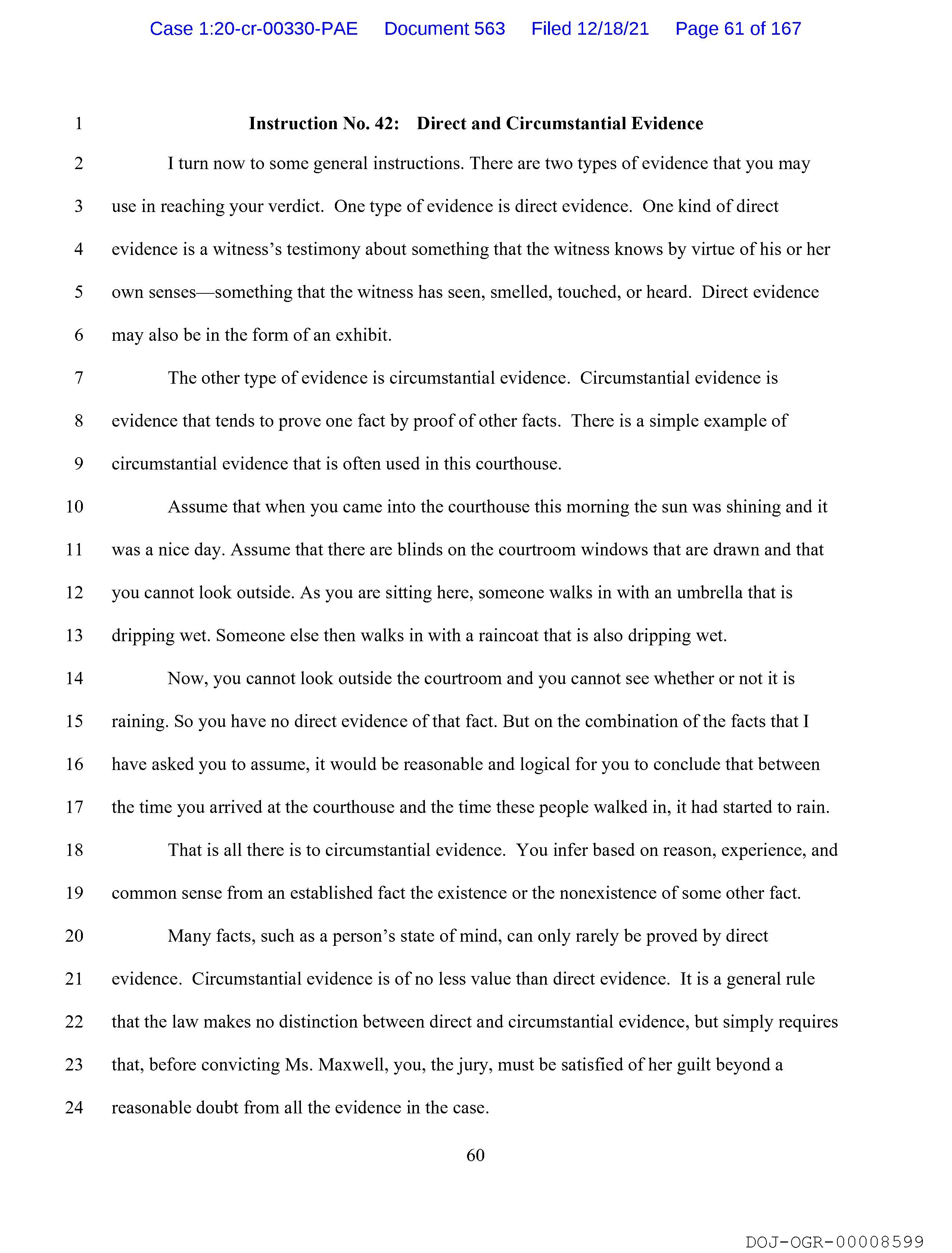
Instruction No. 42: Direct and Circumstantial Evidence
I turn now to some general instructions. There are two types of evidence that you may
use in reaching your verdict. One type of evidence is direct evidence. One kind of direct
evidence is a witness’s testimony about something that the witness knows by virtue of his or her
own senses—something that the witness has seen, smelled, touched, or heard. Direct evidence
may also be in the form of an exhibit.
The other type of evidence is circumstantial evidence. Circumstantial evidence is
evidence that tends to prove one fact by proof of other facts. There is a simple example of
circumstantial evidence that is often used in this courthouse.
Assume that when you came into the courthouse this morning the sun was shining and it
was a nice day. Assume that there are blinds on the courtroom windows that are drawn and that
you cannot look outside. As you are sitting here, someone walks in with an umbrella that is
dripping wet. Someone else then walks in with a raincoat that is also dripping wet.
Now, you cannot look outside the courtroom and you cannot see whether or not it is
raining. So you have no direct evidence of that fact. But on the combination of the facts that I
have asked you to assume, it would be reasonable and logical for you to conclude that between
the time you arrived at the courthouse and the time these people walked in, it had started to rain.
That is all there is to circumstantial evidence. You infer based on reason, experience, and
common sense from an established fact the existence or the nonexistence of some other fact.
Many facts, such as a person’s state of mind, can only rarely be proved by direct
evidence. Circumstantial evidence is of no less value than direct evidence. It is a general rule
that the law makes no distinction between direct and circumstantial evidence, but simply requires
that, before convicting Ms. Maxwell, you, the jury, must be satisfied of her guilt beyond a
reasonable doubt from all the evidence in the case.
60
DOJ-OGR-00008599
Document Preview

Click to view full size
Extracted Information
Dates
Document Details
| Filename | DOJ-OGR-00008599.jpg |
| File Size | 720.2 KB |
| OCR Confidence | 95.0% |
| Has Readable Text | Yes |
| Text Length | 2,187 characters |
| Indexed | 2026-02-03 17:36:28.238984 |
Related Documents
Documents connected by shared names, same document type, or nearby in the archive.