HOUSE_OVERSIGHT_021005.jpg
Extracted Text (OCR)
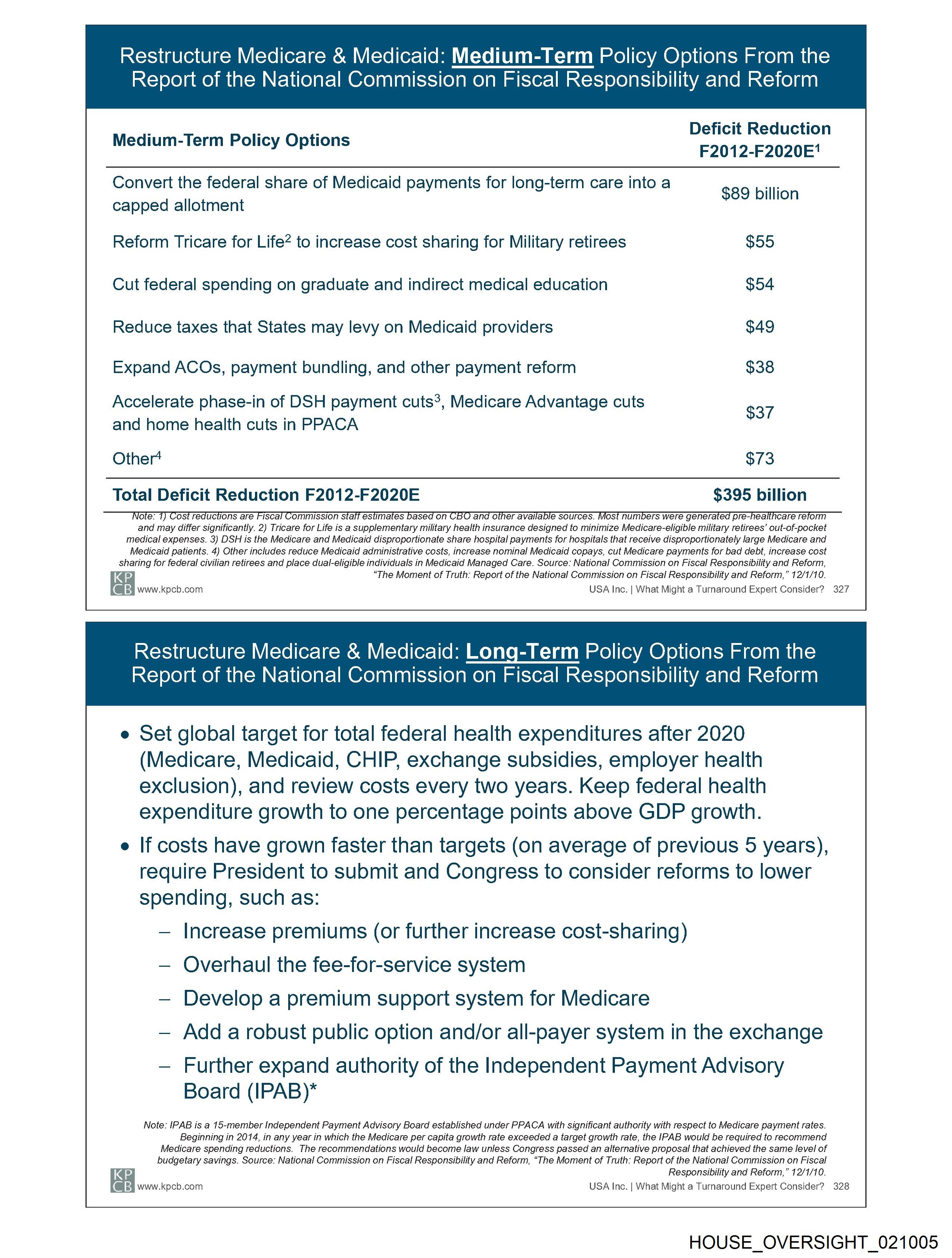
Restructure Medicare & Medicaid: Medium-Term Policy Options From the
Report of the National Commission on Fiscal Responsibility and Reform
Deficit Reduction
Medium-Term Policy Options F2012-F2020E’
Convert the federal share of Medicaid payments for long-term care into a
capped allotment Sees aulign
Reform Tricare for Life? to increase cost sharing for Military retirees $55
Cut federal spending on graduate and indirect medical education $54
Reduce taxes that States may levy on Medicaid providers $49
Expand ACOs, payment bundling, and other payment reform $38
Accelerate phase-in of DSH payment cuts?, Medicare Advantage cuts $37
and home health cuts in PPACA
Other* $73
Total Deficit Reduction F2012-F2020E $395 billion
ore: ost reductions are Fiscal COMMISSION Staff estimates Dased on and oiner avaliable Sources. Most numbers were generated pre-nealincare rerorm
and may differ significantly. 2) Tricare for Life is a supplementary military health insurance designed to minimize Medicare-eligible military retirees’ out-of-pocket
medical expenses. 3) DSH is the Medicare and Medicaid disproportionate share hospital payments for hospitals that receive disproportionately large Medicare and
Medicaid patients. 4) Other includes reduce Medicaid administrative costs, increase nominal Medicaid copays, cut Medicare payments for bad debt, increase cost
Sharing for federal civilian retirees and place dual-eligible individuals in Medicaid Managed Care. Source: National Commission on Fiscal Responsibility and Reform,
KP “The Moment of Truth: Report of the National Commission on Fiscal Responsibility and Reform,” 12/1/10.
www.kpcb.com USA Inc. | What Might a Turnaround Expert Consider? 327
Restructure Medicare & Medicaid: Long-Term Policy Options From the
Report of the National Commission on Fiscal Responsibility and Reform
e Set global target for total federal health expenditures after 2020
(Medicare, Medicaid, CHIP, exchange subsidies, employer health
exclusion), and review costs every two years. Keep federal health
expenditure growth to one percentage points above GDP growth.
e If costs have grown faster than targets (on average of previous 5 years),
require President to submit and Congress to consider reforms to lower
spending, such as:
— Increase premiums (or further increase cost-sharing)
Overhaul the fee-for-service system
— Develop a premium support system for Medicare
Add a robust public option and/or all-payer system in the exchange
— Further expand authority of the Independent Payment Advisory
Board (IPAB)*
Note: IPAB is a 15-member Independent Payment Advisory Board established under PPACA with significant authority with respect to Medicare payment rates.
Beginning in 2014, in any year in which the Medicare per capita growth rate exceeded a target growth rate, the PAB would be required to recommend
Medicare spending reductions. The recommendations would become law unless Congress passed an alternative proposal that achieved the same level of
budgetary savings. Source: National Commission on Fiscal Responsibility and Reform, “The Moment of Truth: Report of the National Commission on Fiscal
KP Responsibility and Reform,” 12/1/10.
(@ EB) www.kpcb.com USA Inc. | What Might a Turnaround Expert Consider? 328
HOUSE_OVERSIGHT_021005

Related Documents
Documents connected by shared names, same document type, or nearby in the archive.